Showing posts with label Natural World. Show all posts

Monday, 24 February 2020

The Best Books: Expedition, Steve Backshall


A return to exploring as it was, in the good old days. Or as close to it as you get in our modern jet-shrunk, digitally mapped, satellite photographed, tourist-travelled, economy-centric world. Harking back to a time where you really didn't know quite what to expect from your journey. When journey times were quoted to the nearest few days or weeks, rather than the nearest minute - and then complained about when not exactly right. When evacuation was a medical procedure, not a hope if anything went awry.


The sort of exploring in other words that I, along with many others I daresay, have dreamed of since childhood, but never had a realistic hope of engaging in. Do I have any greater hopes of doing so as a result of reading this book? Perhaps not. 

I have admired Steve Backshall's approach to things for a while now. He is unusual in the arena of television presenters that he still engages in the getting your hands dirty side of exploration and adventure. He is also unusual in his combining both the knowledge and expertise of the natural world, and ability in the graft of getting to see it in its natural habitat - no matter how remote or inhospitable. 

He also seeks to encourage a younger generation to do the same through his Deadly 60 programmes among others, and his involvement in the Scouts programme, something which I greatly benefited from as a youngster myself. 

I am confident that if we are to make a significant difference in reducing the impact of the human race on the planet then we need to start getting young people more interested in it. Unless they are interested in it, they will not love it enough to give a damn about it. And when they start caring about it, they will pressure policy makers and corporations, governments and industry to start making the necessary changes, or rather stop turning a blind eye to the issues. 

Slightly off tangent, but what this book did for me is remind me of some of the original excitement I had, and still have, albeit buried a little deeper these days, about the natural world as a source of excitement. A source, the best source of the unknown, the untried, the untested, the new, the ground breaking, the earth shattering, the fascinating and the mind blowing. It reminded me as I shadowed Steve on his adventures, that behind the book study, the degrees and the desk job as a conservationist, that my admiration for the natural world goes right back to the little boy who doesn't actually know for sure what is around the corner, over the hill, or under the water, but is pretty confident that it will be cool. 

Mr Backshall has had an opportunity in the endeavours described in the book to live childhood dreams, not just his own, but those of many hundreds and thousands of others. But he has also reminded me, and hopefully the collective 'us' of his readers that we too can find fascination in the unknowns presented by the natural world. And hopefully, going one step beyond, this along with his other efforts will be a small piece in the puzzle of reminded us as a civilisation, that it is worth looking after and protecting. 

And if that wasn't enough, its a gripping tale of adventure, friendship and danger. Definitely worth a read. 

Richard


Monday, 2 September 2019

Meteors & Lighthouses

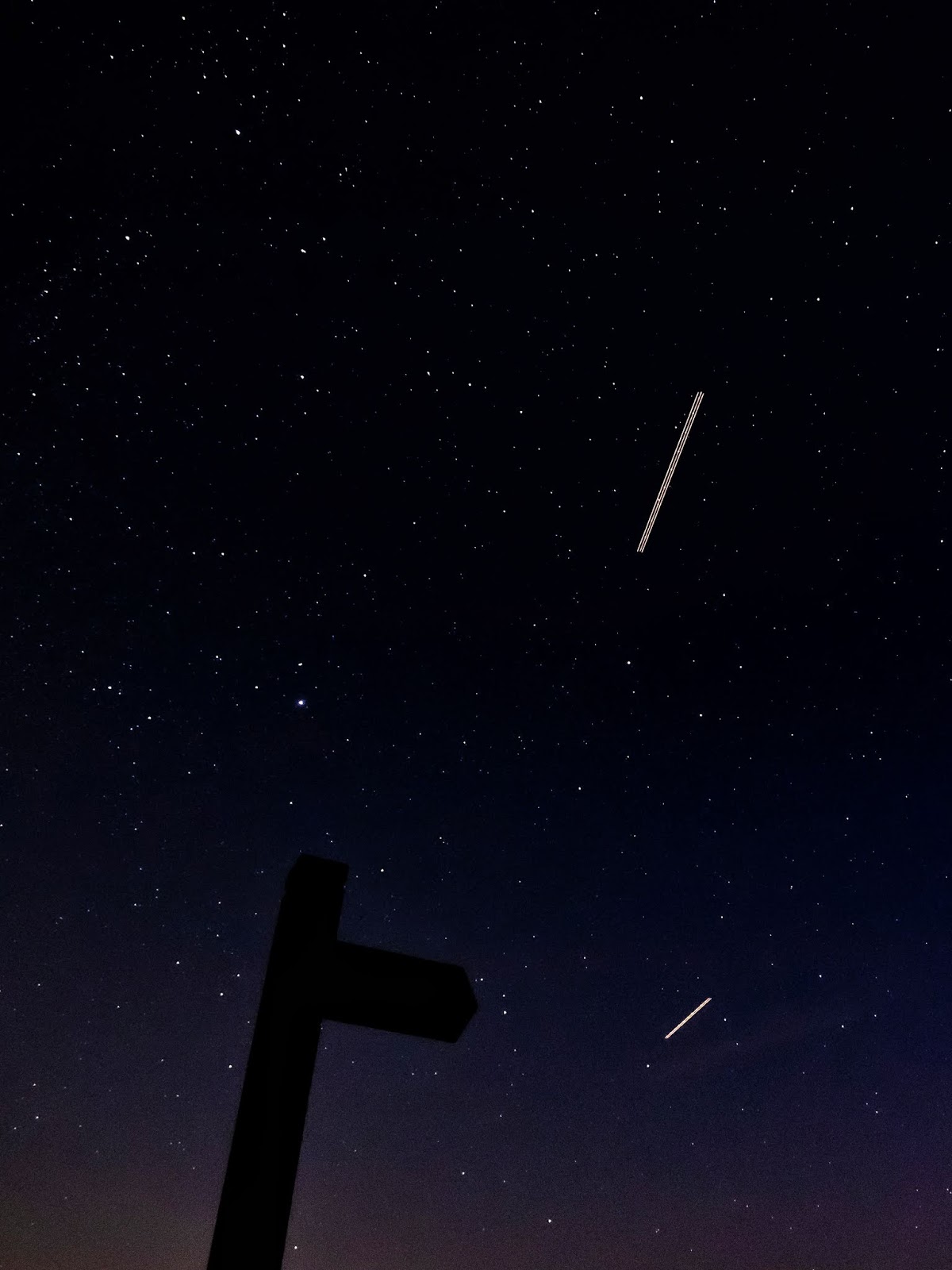
My one meteor photograph of the morning... room for improvement!
It's late on a freezing December night in the mid 1990's. A young boy and his dad give up trying to put up their tent at a friends farm in rural Wales. The ground is frozen solid - without a hammer there is no way they are getting those pegs in the ground. The alternative is the car, which seems like a poor option at first. Wrapped up in all his clothes and his sleeping bag the boy reclines in the passenger seat and hopes he will be able to sleep. But soon sleep is the last thing on his mind because the sky is falling!

Little did my dad and I know all those years ago that by pure chance we had picked the peak of the Geminids meteor shower for our winter camping excursion. The frosty temperatures resulted from a perfectly clear night which revealed a stunningly starry sky. As we relaxed - well, settled at least - into our cold but well windowed accommodation we realised that the 'stars' were a whole lot more active than usual. Meteors were falling, by the hundred. Or so it seemed to my little boys imagination nearly a quarter of a century ago (wow, I am getting old!). 

-------- 

Not meteors, but the planes still look pretty
cool in photos! 
As a result of that experience as a youngster, the chance to watch a meteor shower will always grab my attention. I even took my girlfriend to watch the Perseids shower as one of our first dates just over 10 years ago... given that she has now been my wife for 9 years that worked out pretty well. 

Knowing that this year the peak of the Perseids meteor shower coincided with a break to visit family in rural Suffolk, where light pollution is less of a concern than urban Stoke (who'd have guessed it?!) we planned to try and watch the shooting stars again, this time sharing them with our children. That was the plan anyway. The night before the peak we sat out in the back garden for a few minutes and caught sight of a handful of meteors before retiring for bed, keeping our fingers crossed that the forecast of clear skies the following night would hold true. 

The next night the alarm was set for 2:15 am. Thank goodness I don't do that too often! I got up to check the skies were clear and then returned to help my wife wake up the children... except they would not be woken! Our 7 year old rolled over, pulled the covers over her head and told us to go away. The 3 year old didn't even stir despite extended shaking and repeatedly calling his name. Oh well, maybe next time.

The first of the dawn light competing with the last of
the stars. 
Laid on camping mats in the garden to take in as much of the sky as possible, we watched the 'show' for a while - the best kind of outdoor theatre. We probably saw a dozen or so in the 20 minutes we watched for, but the light spilling over from surrounding houses marred it a little. Emily very sensibly returned to a warm and comfy bed but I, sucker for punishment that I am, wanted to make a little more of the opportunity. I drove the 10 minutes out to the coast where I hoped there would be less light pollution to watch for a bit longer. It was worth the drive!

I also wanted to try to take some photo's, hoping to catch a shooting star or two. My previous attempts at astrophotography have been amateurish at best, and I didn't think these would be much better, but you've got to start somewhere. I set the camera up and took some test shots then set the camera running taking continuous shots hoping that a meteor would coincide with one of the images. The results were not great, but it was a chance to practice the technique at least. I caught one shooting star, a tiny smudge of a meteor - I think I picked the wrong bit of sky to point the camera at. Never mind, lessons learned. 

While laying on the ground looking up at the sky listening to the camera shutter repeatedly opening and closing, I became aware that the footpath sign just beyond my feet had changed shape. Confused and assuming I had dozed off and that my eyes were playing tricks on me, I stared harder at the sign. It moved. It took me another second or two to realise that the new shape was that of a Barn Owl which must have silently alighted while my gaze was directed elsewhere. It sat for a moment before going on its way with scarcely a sound - I think it heard me shift position for a better view. Having an owl, or any other wild animal for that matter, approach to within 10 feet of you is a pretty good way to start any day. And my day really was only just starting, it still wasn't even 5 am at this point!

I probably saw another 30 or so meteors before dawn started to colour and brighten the eastern sky, fading the stars until only the very brightest were still visible. Given my location on the east coast it would have been rude not to hang around for a bit longer to watch the sun rise out of the North Sea, a sight I don't get to enjoy all too often. I wandered north along the shingle for a few minutes until Orford Ness Lighthouse was more or less in line with where the sun would rise and waited. I figured the lighthouse would be a worthwhile addition to any photo's I may take. While completely alone, I was not without company. Hundreds of sea birds were waking up and flying off. Many of them had clearly roosted in the safety offered by the single spit of Orford Ness. The fisherman were up too - several trawlers chugged past me heading for deeper waters and pushing a wave after wave along the shore as I waited, each peeling off a cloud of gulls as it passed.

With half an hour or more until the sun was due to rise I played about with a few time lapses of the rolling clouds and brightening sky until the sun poked out from behind a large cloud on the distant horizon. It wasn't the most dramatic sunrise I've ever seen, but there is something about being witness to the birth of a new day which never gets old. Heading back towards the car, there was a lot more light to see what I had unwittingly passed earlier. Brown hares and curlews sat in the pastures reclaimed from the surrounding salt marsh. Reed buntings and other small birds sat atop the swaying reeds which lined the ditches. A lone seal, lounging on the shingle, stirred lazily as the day brightened, clearly contemplating the right moment to go in search of breakfast. I had been making a similar decision and was hoping that I'd be back in time to grab not only breakfast, but also 40 winks before the rest of the household woke up too!


Richard


The first peek of the sun rising behind the Orford Ness light house. 


Wednesday, 19 June 2019

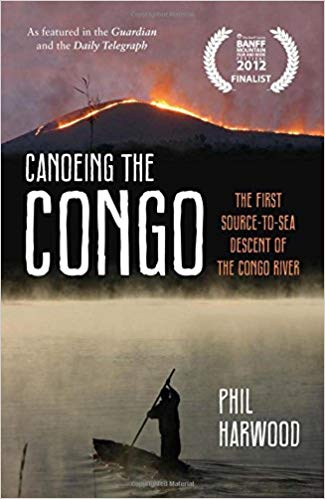
The Best Books: Canoeing the Congo

I've finally finished another book - it takes me ages these days. I used to go through books by the shelf load but real life is busy and by the time children and full time job and other commitments come along ... reading time is sparse and frequently cut short by sleep! 

Anyway...

I came across this book by accident, I'm pretty sure it was a suggestion from Amazon when purchasing a couple of 'adventure books' from my long, very long wish list. But I committed that cardinal sin - judging a book by it's cover - and decided that this was a book I needed to read. 

It ticked several boxes for me straight off the bat: 1) I bought a canoe, sorry - kayak, earlier this year as a new tool in the adventure tool kit and 2) I've always loved the idea of source to sea river journeys whether by land following the river or on the river, and 3) Africa calls my name - I need to visit one day. 

I completed my first source to sea trip last year, almost exactly a year ago in fact, and it was a journey I had been thinking about since I was a little boy! It only took me 20 odd years to realise the plan. It was much smaller than the Congo and didn't go exactly to plan anyway, but was a great journey and learning experience none the less. My source to sea journey was following the Ystwyth river in mid Wales - you can read about it here. It will not be the last source-to-sea journey I do, that is for sure. 

But the book! Well it does what it says on the tin... or cover. It recounts the journey of Phil Harwood down the full length of the river Congo by canoe - the bits he could traverse without being obliterated by raging, white water anyway. Geography has always fascinated me and the Congo is a river I had certainly heard of, but could not have told you anything about the river, with the possible exception of fact that it flowed through the country of the same name.  I now know a lot more, but this book is a lot more than a geography lesson.

This certainly isn't one of those natural history books which waxes lyrical and poetic about the 'personal journey' or anything like that. It is more a diary of what by any standards is a blooming exciting and even terrifying journey. Crocodiles, Hippos, occasionally angry and threatening locals, biblical rapids, literally uncharted territory AND setting off to do it on his lonesome. Phil may not be the most gifted or flowery author but he is clearly a pretty brave chap. 

Of course the trip is not all danger and isolation. It also illustrates the diversity of the world we inhabit and that there are good people everywhere. And it is a cultural and sociological insight into just how easy I and others like me have had it; a relatively wealthy up-bringing in a peaceful, European nation. I like to think that I am a little more aware than some of the scale of the privileges I have been blessed with. I lived in South America and the Caribbean for a few years and while there was witness to unquestionable and genuine poverty, but one thing which wasn't present even in those poor nations was the aftermath of decades of war and civil unrest which are still making their presence felt even years later. 

Has it lessened my desire to visit Africa? No. Has it opened my eyes to what the realities of travelling in that continent may hold? Yes, I would say it has. Will I be disappearing off to canoe the Congo myself anytime soon? No, for starters my wife wouldn't let me! 

Which brings me on to the final point which this book highlighted for me - that long, solo canoe journeys and water travel in general are not to be taken lightly. I better get training then!

To anyone for whom adventure, travel, far flung places, the splendour of the natural world or the diversity of human culture and experience holds any interest, this book is worth the time to read, even if like me your reading time is short and precious!

Richard


Thursday, 14 February 2019

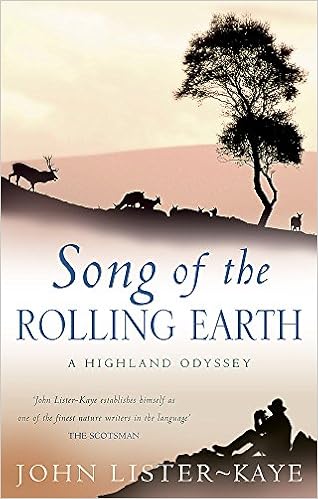
The Best Books: John Lister-Kaye - Song of the Rolling Earth

Image result for song of the rolling earth cover imageOK, so I will start this review by being honest - I finished this book over 6 months ago and forgot to write about it at the time. Now, I can't remember quite as much about it, which puts a bit of a damper on writing a review about it. But, one thing I remember very clearly is that you should read it. Anyone who has any interest at all in natural history, British wildlife, Scotland - including its cultural history, conservation, success stories, family life, adventure, wilderness or the peace and tranquillity of wild places will enjoy this book. Especially Scotland.

I remember that it doesn't read as if he set out to write a book, rather that he spent a long time living life to the full and in looking back realised that other people may find it interesting. And I for one certainly did. I liked it enough that I immediately bought another of his books and will continue to add his works to my collection as pocket money, shelf space and the seemingly never-dwindling back log of books to read permits.

I had long been aware of the Aigas Field Centre, though pretty sure I've been mispronouncing it the entire time, so thought when I first heard of this book that it would be an interesting read. But it is so much more than simply the story of how the Field Centre came to be - it is the story of someone who had a dream and, having worked their socks off for it, achieved it and a whole lot more besides. And for that I commend Sir John.

One story which I remember more clearly than many of the others which have faded (this is certainly a book I would read again to sharpen those memories) is the account of a boat trip down a river with his young daughter where they came face to face with an otter while resting on the bank - what a experience. I took it as a reminder to me that the ideas and plans I have for my daughter (and son when he is a bit older) to join in my 'adventuring' and ongoing learning about the natural world and its pleasures and intricacies don't have to be pie-in-the-sky. They really can happen and they really can make a difference - I just have to make the effort to get them off the ground.

Reading Song of the Rolling Earth while waiting in
my tent for dinner to cook on Vatersay in the Outer
Hebrides, Scotland. 
 
While I have taken many things away from this book - an even greater love of Scotland, an admiration of Sir John and the power of working towards your dreams despite opposition and discouragement, an increased sense of humility that I have been born in an age and in a place where I really have had it easy to name just a few examples - perhaps the greatest lesson I will cling to is that dreams come true in Scotland... and perhaps other places too.

I'm glad I got to read at least a portion of this book while in Scotland myself. Walking and wild camping around an Island in the Outer Hebrides which still hosts the crofts and small rural communities which are described to some extent in the book. That trip was in itself a dream come true for me. A dream probably 15 years in the making and it lived up to the expectation and anticipation that had been accumulating over that time.

In conclusion I would propose that the "Song of the Rolling Earth" Sir John describes throughout this book is the soundtrack of dreamers. OK, that was a bit flowery, just read the book already.

Richard

Thursday, 8 March 2018

Wild Moments: The precious privilege of cultivating the spirit of adventure in a young heart.


** Another 'Wild Moment' considering something close to my heart - family, children and introducing them to the natural world and adventure **

Life is busy, isn't it? I'm sure it's not just mine. Commitments pile up, calendars fill and free time dwindles at an ever increasing pace. I often talk of needing to 'make' time and it sometimes does feel like a significant project to engineer opportunities for time out of doors, or for 'an adventure'. Adding children to that mix doesn't make it easier (or cheaper) - 'bed time' is suddenly 4 or 5 hours earlier; a 'good nights sleep' becomes an exception rather than an expectation; a 'walk' with a toddler can be considered long if you leave the car park rather than the county!

BUT - and it is a big one - as a parent you have an opportunity to plant the spirit of adventure in a fresh heart, and to see the excited twinkle of exploration in new eyes. I have always loved the outdoors, I still do, and I am fairly confident that I always will. I still enjoy spending that time in the natural world alone and at my own pace (which I like to think is reasonably quick... unless I'm taking photos). But there are very few things I enjoy more than witnessing the excitement in the eyes of our children when they are presented with the opportunity to do something new, something adventurous! Adventurous to them is at a different place on the spectrum than it is for me, of course it is. After all every one starts somewhere - Sir Edmund Hilary didn't start with Everest, nor was Amelia Earhart's first flight an around the world venture. *Add your favourite example of an intrepid adventurer here*. 

As parents we have tried (there is still a lot we could do better) to cultivate that adventurous spirit in our children because we hope that if we start them young that it will sink deep and they will seek 'adventure' for the rest of their lives. Yes, there are times when this meets with resistance: 'it's too cold', 'it's too wet', 'it's too windy', 'it's too sandy'. But that resistance will weaken over time. Our daughter once spent a whole warm, summer day on the beach sat in a folding chair with her feet on a towel because she refused point blank to get sand on her feet! The following year we visited a Scottish beach in April (it was much colder!) and she loved it! She played in it, rolled down sand dunes, dug holes and jumped in them - when we got back to where we were staying there was sand everywhere. Stick with it and the resistance will fade.

I was 24 when our daughter was born - that is pretty young these days to have a first child and I often have conversations where the reaction to learning this (sometimes spoken and sometimes inferred) is that my opportunities for fun therefore ended at 24. But I see it entirely differently. The way I see it is that when she becomes a teenager I'll still only be 37 (and 40 when our little boy becomes a teenager). Hopefully I will still be fit enough at that relatively young age that I will still be able to keep up with them when they take that spirit of adventure which we have instilled in them and want to do something really interesting!


So yes we may have sacrificed some of our perceived freedom as young adults to have a family early. But to me, rather than missing opportunities for fun and adventure, we have created the opportunity further down the road to share our fun and adventure with the people who matter most to us - our children.


Sunday, 11 February 2018

Snowdon - at last.

Oh no! The alarm hadn't gone off - I'd overslept!

Except I hadn't. I'd just dreamt that I had. This recurring (and very irritating) dream plagues my sleep whenever I have something exciting or important to look forward to the next day. And I certainly had something to look forward to. Even the thought of a 3:30am wake up and a long drive were not enough to dampen my spirits.

I dragged myself out of bed after what felt like a woefully inadequate sleep; that dream has a lot to answer for! My kit was all packed and stacked ready to go. After well over a decade of procrastination I was finally heading to Snowdon.

Having double-checked and loaded my kit, I left home and headed west for the Welsh border. On my drive I listened to the audio book of that classic tale of British wilderness (albeit Scottish rather than Welsh wilderness) 'The 39 Steps' by John Buchan. The sky was bright with a nearly full moon, although I knew that clouds were forecast to be my fate as my journey progressed.

Sure enough shortly after I crossed into the land of the Red Dragon the clouds blocked the moon as completely as if I had driven into a cave, limiting my view of the wider world to the reach of my headlights for the remainder of the trip. I made good time across Wales - at that time of morning traffic isn't exactly heavy - and arrived at Pen-y-Pass car park and the proper start of my days adventure at about 6:30am.

Here I listed my spare kidney on Ebay to fund the parking charges, donned my warm clothes and a head torch and rechecked the map of my route. When I initially started planning for my trip to Snowdon I had hoped to complete it in milder weather and follow the Snowdon Horseshoe route, along two precarious ridge lines up to and back down from the summit. When I learned that there was sure to be snow on the higher ground, and that I would need to start my ascent in the dark because of when I needed to get home, I shelved that plan for a later day. The revised plan was to get as far into the ascent as possible as quick as possible in case there was a sunrise worth photographing. So I settled on the broad and well surfaced Miners track and started on up.

The thick cloud still obscured the moon, and sunrise was still over an hour away so I began in total darkness with no view ahead, but I knew that the mountains towered ahead of me. Soon a few chinks opened in the cloud letting through the first hints of dawn and giving me enough visibility that I could turn off my torch. As my eyes adjusted to the new, lesser darkness I could make out a snow capped outline ahead of me! I assumed this was Snowdon and smiled to myself, my goal was in sight - I was wrong though. What I could see was just a part of the ridge, some 300m below the still cloud bound summit.


The Miners track is straight forward and easy going until the far side of Llyn Llydaw where it gets a little steeper and rougher, but it is above Glaslyn that the path, and the view, starts to get really interesting. This is about 2/3 of the linear distance into the route, but only 1/3 of the vertical ascent, leaving a steep route to negotiate over the last few kilometres. It was also around this point that the laying snow became persistent and the rising sun started to break through a chink in the low hanging clouds. The combination of cool blue lake, majestic snowy mountains, broken cloud and warm sunlight made for a breath taking view!

But the concept of 'a view' was about to become irrelevant. The laying snow and the lowering cloud merged into a wall of white before me. I lost the route of the path in the snow several times and struggled to gauge how much further I had to go. I couldn't see the track 30 meters ahead at times, let alone the summit. The wind driven snow had done a comprehensive job of smoothing out the hill side, blending series of steps into smooth icy slopes. With the aid of poles and studded snow walking aids (proper crampons don't feature on my kit list yet) I made it to the summit ridge feeling in my inexperience as close to a proper alpinist as I've come yet, with just a short walk along the ridge remaining to arrive at the actual summit.


The ridge looked alien! The frigid temperatures and driving winds over the preceding days had sculpted icy feathers over every inch of it. Snow remained only in the most sheltered of spots, the rest blasted off by howling winds. The swirling ice traced the eddies of the wind as clearly as smoke in a wind tunnel and coated the entire landscape, with only the dark rocks beneath breaking the white of the ice. The now brightening cloud still firmly clamped on top of the mountain cast a flat, contrast-less light uniformly over the ice-coated everything and created conditions unlike anything I have seen before - a completely monochrome landscape.

The summit cairn and trig point looked like a chaotically iced wedding cake, and the deserted train station like a movie set from 'The Day After Tomorrow'. I was the first to the top that morning - no one else had been crazy enough to start out for the summit as early as me - and the solitude was palpable, although short lived. A trio of walkers had been gradually catching me for the past hour while I kept stopping to take pictures and they arrived just a few minutes later. I'd like to think that pioneering a path through the fresh, unsullied snow for them had slowed me down, but the reality is almost certainly just that they were faster than me!


I didn't stay long at the top. I had made my pilgrimage, had my adventure. Call me anti-social but sharing these special places with throngs of other people spoils it for me. More often than not it is the solitude itself that I am seeking, and the personal challenge of completing the ascent in the first place, the views are a bonus, but a very welcome one when they are there! Sure enough I passed many other hikers toiling upwards while I descended, but even when the cloud lifted and the iced-gem summit appeared against a bright patch of blue I didn't envy them, because they had to share it, and I had had it to myself, if only for a few minutes.

Now that the clouds had lifted and the sun was properly up the views on my trek back down were every bit as stunning as you would expect of the Snowdonian Mountains in winter. Snow capped peaks were there to be seen in every direction and the low winter sun picked out the finest of topographical details in a landscape which begs the question why we Brits ever feel the need to travel abroad to see beautiful scenery. I made it down about 5 hours after I originally left the car. I shed my cold weather kit, now feeling distinctly over dressed among gaggles of children and young couples who at midday were only just arriving. I left quickly, keen now my adventure was over to get back to my family for the remainder of the day. A few miles away I had to stop and take in the view behind one more time. The clouds had now lifted fully and the snowy summit of Snowdon had revealed herself to all the world. It was the perfect parting memory, one that is certain to bring me back again soon. This may have been my first visit to Snowdon, but it won't be my last!


Richard

Saturday, 27 January 2018

The Best Books: Rob Penn - The Man who made things out of trees

I think anyone likely to be reading this will have gathered by now that I love the natural world. For the avoidance of doubt: I LOVE it! Everything about it.

Not just being in it and watching it (although that has to come top of the list), but reading about it, learning about it, photographing it, conserving it, working in it and with it, watching other people enjoy it, teaching other people about it and introducing my family to it.

One aspect of my enjoyment of the natural world that I don't often talk about is working with natural materials. While my skill level is very low (hence not talking about it much, but perhaps I should mention it more - watch this space) my enjoyment of working with natural materials, primarily wood is huge. The process of making the few things I have managed to construct from scratch has been addictive; the satisfaction of producing something functional (rarely beautiful from my hands) from something natural is not to be under-estimated. I am fascinated by the unique properties of natural materials, their frequent lack of uniformity. More often than not the best way to make the most of the material is to work with its individuality rather than in forcing your own will upon it and that requires consideration and problem solving.

I first came across Rob Penn when I saw his documentary series on BBC - Tales from the Wild Wood - the story of his project to rejuvenate an old, unmanaged woodland near his home. I was fascinated - I've always loved the idea of woodland work, coppicing and felling trees, splitting firewood, using the harvested material to make and sell things of value and function. I was envious of Rob to say the least, and ached for an opportunity to be involved in something similar myself. So a few years later when presented with an opportunity I did so - setting up The Riddy Wood Project with my brother (more on that another time).

Since that time I've seen glimpses on social media of Rob's involvement in the Small Woods Association, Woodland Trust and similar campaigns promoting sustainable use of British woodlands and trees. As soon as I heard this book was to be released I knew it was one I would like to read - and I did.

There are books which cover a broad topic with a light touch approach, providing for the reader only a scratch-the-surface-deep knowledge of many aspects of the subject. This is not ones of those books. He has taken one, very specific subject - the Ash tree - and drilled deep down to the depths of what there is to know. From the trees biological traits, its geographical distribution and physical attributes to its historical significance and use, and its modern day relevance, Rob has clearly delved deep and provides a fascinating, educational and easily readable account of his journey of personal learning and discovery into the Ash as a tree, a material and a symbol. Literally travelling across continents to fill gaps in his understanding he has left no stone (or perhaps leaf would be more appropriate) unturned in his account of how, what and why the ash holds a special place in his heart, as well as in the hearts of many others across the world.

In doing so he has also opened a doorway into the world of traditional craftsman and skills fighting to remain relevant in a mechanised and hydro-carbonised global economy. What place does a hand turned ash bowl or a steam bent ash chair have in this mass produced, throw-away society? It's place is the one we make for it - these skills will die once and for all if the people who appreciate the tradition and the talent and the art behind them dry up and turn to anonymous and soul-less alternatives. These sort of items aren't the cheap option any longer, but they are are more than just the sum of the parts of which they are constructed or formed; they are a symbol of what has gone before and an icon of what can yet be a sustainable and effective and viable and beautiful resource going forward into the future. 

In case you hadn't already cottoned on, I would thoroughly recommend this book to anyone. Whether your interest lies in the historical, the ecological or the artistic, in engineering, in traditional rural crafts or in general knowledge and interest; there will be something of interest to you.

Richard


Wednesday, 24 January 2018

Wild Moments: The UK Cat Conundrum

** 'Wild Moments' posts are going to be a new thing for me in 2018 and will be 
mini-posts (perhaps written during a lunch break) on pretty much anything (relevant 
to the things I write about) which has caught my eye. There is a risk they will 
contain opinions (insert dramatic music here), but I hope they will mostly be 
balanced and well considered and maybe even educational - I live in hope! **

Wild cats in the UK. A divisive but popular topic at the minute and something which has been bugging me for a while. 

The debates on this subject at present focus on the very high profile and quite popular (in some circles) campaign to re-introduce Lynx to the UK. I've read quite a lot of material, from both sides of the argument - although I think there are more than 2 sides to this particular argument to be honest. I've even gone back to cited source material and read scientific papers about other reintroduction schemes else where in Europe to get the true context of the claims being made. I love the natural history of the British Isles and anything which aims to preserve or enhance the 'wildness' of my home countries is as far as I am considered a worthy venture. Further more as an adventurous sort of chap I would welcome the chance to catch of a glimpse of a lynx or for that matter a bear, or wolves or a moose wild in the UK.  

BUT - I do not agree with the sentiment below. It is not time to bring them home... not yet.

Image result for lynx reintroduction

The reason for this is nothing to do with the issues surrounding predation of livestock (although I think this a valid concern which I do not think is being taken seriously enough by those advocating the reintroduction). Nor is it due to concerns about the plans, locations (although I was staggered that Thetford Forest was considered as an option! I'm glad that was withdrawn from the final proposals) or poor attempts at cooperation with 'the other side' - the farming community.

It isn't even to do with a certain level of naivety which I feel has been displayed at various levels of the campaign - my biggest bug bear of which was what seemed to me like a deep seated lack of understanding of the importance of range sizes, population densities and the importance of a genetically sustainable population, but which also included the closed minded disregard of the potential threat, however small they deem it to be, to other peoples livelihoods. 

No, the reason I am against it is that while all this effort (and money!) is being poured into the proposed reintroduction of a species which we as a civilization have already failed, we are STILL failing its closest surviving relative in the UK - the Scottish Wildcat. Depending on which report you read (or believe) there are as few as 25 pure Wildcats left (now solely in Scotland) of a species which used to be far more wide spread throughout the UK. And the story is very similar to that of the Lynx - persecuted as a perceived threat to what is deemed more important. Of course with the Wildcat you also have the added complication and threat of hybridization from domestic cats which are allowed to roam free. Yet another example of humans ability to ignore the consequences of their actions and 'we've been doing it for years and we'll keep doing it'.

So there you have it, my reason for not currently supporting the Lynx reintroduction campaign is that I would much, MUCH rather see the vast expense that will inevitably be poured into the plans if they go ahead go into the pre-existing efforts into saving the wild cat we still have, because otherwise we will be in a position where we've lost that too!

Image result for Scottish wild cat conservation

Richard

Saturday, 30 December 2017

'The Best Books' - Robert McFarlane: The Wild Places


Reading is a luxury I don't get in large quantities these days - work, family, church, part time work (glorified hobbies), photography - they all take their chunk of time. As a kid I used to read loads and when we first got married, before I started University, we both used to read loads together - probably because we couldn't afford to do much else! These days what would have been my typical reading time - the period between going to bed and falling asleep - is often so short that reading the blurb in one go would be a struggle.

Anyway - that slightly off topic waffle goes to explain why it took me nearly two years to finish reading this book, but it was certainly worth persevering!


I'd been aware of Robert Macfarlane as an author for a while but not had an opportunity to read any of his books until a few years ago when I requested a few for a Christmas present (or Birthday... I can't actually remember!). Thereafter I started reading it in fits and spurts as time allowed, which often meant while I was away from home on trips - working in the woods, holidays visiting family and so on - when the normal routines which fill up your day were disrupted enough to free up a bit of time in the day. These are also the times when I am most likely to be able to spare some time for adventure, exploration and time spent out of doors in the peace that the natural world provides, either as a family or occasionally solo. 

And this is the core of the 'The Wild Places' narrative. It is certainly something that resonates with me - an exploration of the last places in the UK which can still be considered as wild, what an adventure! I'm lucky enough to be familiar with a few of the places he visited in the writing of the book. I even read the chapter about coastal wildness - which recounts a visit to Orfordness on the Suffolk coast - the night after a micro-adventure of my own in that area. My in-laws live just a few miles from Shingle Street, the little hamlet where the spit fades away and joins the North Sea. My brother in law had recently acquired a set of inflatable canoes and had been looking for a chance to try them out. Being mid-summer we made the most of the long evening and stole away for a few hours to try the new toys. The sunset canoe expedition which followed is a fond memory which I have written about before and took us up river toward Orford flanked by Orfordness to the East and the salt marsh on our landward side. We stopped briefly on the shingle to enjoy the views before heading back to our start point... a journey made far more difficult by the tide which had turned and was now racing in. We ended up walking back to the car, beaten by the speed of the inbound tide which rendered our inexperienced paddling completely useless as we struggled to not be drawn back inland, let alone making significant forward progress!

Suffolk was among the tamer landscapes and habitats described. Trips to islands, far flung, dune clad coastlines, limestone pavements and the hidden world within there shaded grykes, windswept moorland, barren mountains tops and snow covered bogs with the shadow of ancient woodland are all described in a detail which simultaneously transports you there in person while instilling a burning desire to make a similar pilgrimage to such places yourself . Ever since reading about a night Macfarlane spent on top of Ben Hope near the north coast of Scotland I have been trying to find a reason to justify the 1000 mile round trip to see it for myself. I haven't found a reason yet... but it isn't going anywhere, I'll figure it out someday. 

Of course his trip to the Hope Valley in Derbyshire to look for mountain hares is something I can recreate far more simply - given that my office is in the valley next door! That's not to belittle the experience, I still love to see the white hares bounding away, particularly when there is snow on the ground. So far this year I have been tied up with office work and haven't been up on the hills yet to see them in their winter coats. Luckily there is certainly good opportunity for me to do so in the new year and I'll be sure the make the most of it! It is easy to forgot - working there everyday - that to so many people in the UK coming to the Peak District is a way to escape the daily grind of work, whereas for me, it is work. 

The picture at the top of the page was taken while on a short trip of my own - I was on route to watch a rugby game in Cardiff with my family. Having spent many of my formative childhood years in Wales I made the most of the opportunity by travelling down through Wales revisiting old haunts. In the evening I travelled to the end of the Gower Peninsula on the south coast of Wales to watch the sun go down over Worms Head. It wasn't long after I had acquired my new camera and I attempted to capture the scene with a time lapse... it wasn't the greatest success (you can watch it here if you really want!), but it gave me an hour on a wild coastline to sit in beautiful surroundings and read about Macfarlane making a trip to a comparable coastline a few hundred miles north, only he was approaching from the sea.

I won't go on - discussions of this nature get my mind racing through the long list of places I'd like to visit. And while patience is certainly a virtue it's not one I'm blessed with in abundance. There is a real risk I will lay awake at night dreaming of the Cairngorms, or the Outer Hebrides, or the wild rivers of mid-wales where I swam as a child, or the rugged coastline of Devon where I camped as a teenager... you see what I mean!? Much like 'The Wild Places', my list of dream destinations are largely in the UK. We are blessed with such a diverse island, or series of islands, that international travel isn't necessary if you goal is to visit wild places. If you're struggling for ideas then reading 'The Wild Places' will certainly give you food for thought, in fact it will be a feast! 

Follow Robert Macfarlane on:
Twitter:       @RobGMacfarlane
Instagram:   @robgmacfarlane

Alternatively have a look at all of his books here at his Amazon author profile.


Wednesday, 6 December 2017

Working in Conservation: Moors for the Future Partnership - My Day Job

I have often mentioned 'work' and posted images I've taken while out working or on my way to work or some variation on those themes. I've been asked by several people what on earth it is that I do for work! So I wanted to answer that question in some detail. I'd also like to use this to kick start an ongoing series on working in conservation in the UK. 

In later posts I'll talk about my work at The Riddy Wood Project and give my perspective on the good, the bad and the ugly (and the beautiful) of working in the conservation sector in one way or another over the last 7 or so years (wow, it has been that long!). I have no doubt there will be other posts to come after that too.

------------------- 

Since June 2016 I've been working for the Moors for the Future Partnership full time as a Conservation Works Officer. You could say it is my first proper job in the conservation sector as prior to that I had only done part time, seasonal or voluntary jobs. Moors for the Future are a partnership organisation headed up by the Peak District National Park Authority but also including the National Trust, the RSPB and several water companies. As the name suggests the focus of the partnership is protecting moorlands (in the Peak District and South Pennines) for future generations.

Edale Valley, Derbyshire
Not quite the view from my office, but my
office is in this valley, just out of frame (left) 
There is plenty of information on the Moors for the Future website (linked above) but to give a quick run down: the peatlands of the South Pennines are (or were at any rate) some of the most degraded anywhere in the world as a result of years of atmospheric pollution, drainage and wildfire. This came about largely as a result of the industrial centres surrounding the moors and the air pollution that resulted from those industries, but also from short sighted agricultural policies and unsympathetic management practices. This damage resulted in large scale loss of critical plant species from the moors and eventually led to complete vegetation loss over large areas and the associated erosion of the peat soils. This causes problems down stream as well as up on the moors as the peat soil washed off the hills, silted up reservoirs and increased the cost of water treatment among other things.

In about 2003, what was to become Moors for the Future (MFF) started work to address these issues. Fast forward 13 years through several rounds of funding from various sources and of various sizes and we get to 2016 when I joined the team. The year before a new funding stream had been secured, a second EU LIFE funded project called MoorLIFE2020. At the time it was the largest grant from the LIFE programme for a environmental conservation project in the UK - €12 million. The increase in work resulting from this new funding stream required extra capacity and I was in the right place at the right time - often the way jobs in conservation come about - and got one of the two roles being offered.

On this occasion the 'right place' happened to be working with a conservation works contractor - Aitch Conservation - building a footpath across Brown Knoll, an exposed ridge to the south-west of Kinder Scout in the Peak District. The 'right time' was the winter and early spring and it didn't always feel like the 'right time' to be working up there to be honest! The footpath project was being run by MFF and during my time working on the path I got to know a few of the staff a little who tipped me off to the upcoming recruitment and suggested I may want to apply. I did and here I am.

But what do I actually do? I work in the CaLM team (Countryside and Land Management - there is a certain irony in the acronym I have to say!) which is responsible for the physical 'on the ground' conservation and restoration work such as bare peat re-vegetation, gully blocking and sphagnum reintroduction. (There are also Science and Communication teams within MFF which do pretty much what they say on the tin.) We work as a project management company when it comes to our works delivery and as such we don't actually do any of the works ourselves, rather we contract it out to specialist contractors. 

I am one of a team of 6 Conservation Works Officers (CWO's) although we are soon to be expanding that number. Our day to day job includes land owner engagement, site surveys, writing work proposals, tendering for conservation work contracts and supervising contractors. Throw in the odd bit of preparing funding bids, working with Natural England as moorland restoration experts and occasionally assisting other teams with public presentations and you have a fairly comprehensive idea of what I do. 

Moving heather brash for a bare peat re-vegetation
contract in the Peak District National Park. 
Oh, and helicopters - nearly forgot. Understandably that catches a lot of peoples attention. As so much of the work we coordinate takes place miles from any sort of road, and often requires transporting tonnes of material (literally - often hundreds, and in some rare cases even thousands of tonnes) the only way to get those materials to the site is by helicopter - and yes, I do occasionally get to have a ride! Yes, it is cool. No, the novelty hasn't worn off yet. One of the better perks of the job for sure!  

So I do spend a fair bit of time outdoors 'in the line of duty', certainly more than most office dwelling folks. And because of the nature of the work, when I am out doors, it's normally in some pretty scenic places. Predominantly at the minute in the northern half of the Peak District National Park, but also further north into the South Pennines on occasion and for some recent projects short spells into the South West Peak too. But it certainly isn't always in good weather. In fact between April and August, so certainly the best 2 or 3 months of the three, we're not really allowed up on the hills at all on account of that being the breeding season of the ground nesting birds which breed in the uplands. This and other time restrictions means that the majority of our conservation works contracts run over the autumn and winter months, which is always when we spend the largest proportion of our time out and about. BUT - I subscribe to the philosophy that even a bad day out of doors is better than a good one stuck inside, so I can live with that.

It's not all helicopters and hill walking of course - writing contracts and managing budgets doesn't exactly get my heart racing and that type of task makes up a pretty big chunk of my day to day work. And while the scenery of my commute through the UK's original National Park takes some beating, at least on the days when you can see it through the fog and low cloud (as hopefully my photo's regularly illustrate - take a look at my hash tag #aconservationistscommute on Instagram) nothing makes the 70 mile a day round trip commute any shorter.

So that's what I do for work - is it a perfect job? Not for me perhaps, because I tend towards being a hands on kind of person. In an ideal world I'd prefer to get my own hands dirty and do at least some of the work myself. Is it a good job? Definitely. Because the changes which are made through the work we do (or coordinate and facilitate) make real, noticeable and measureable differences to the habitats we are working on, and by doing so, provide significant benefits to local communities.

Next time I'll fill you in on my work on The Riddy Wood Project which is how I get my needed fix of hands on conservation work and hard, outdoors manual labour!

Richard


Monday, 20 November 2017

Who doesn't love Autumn?


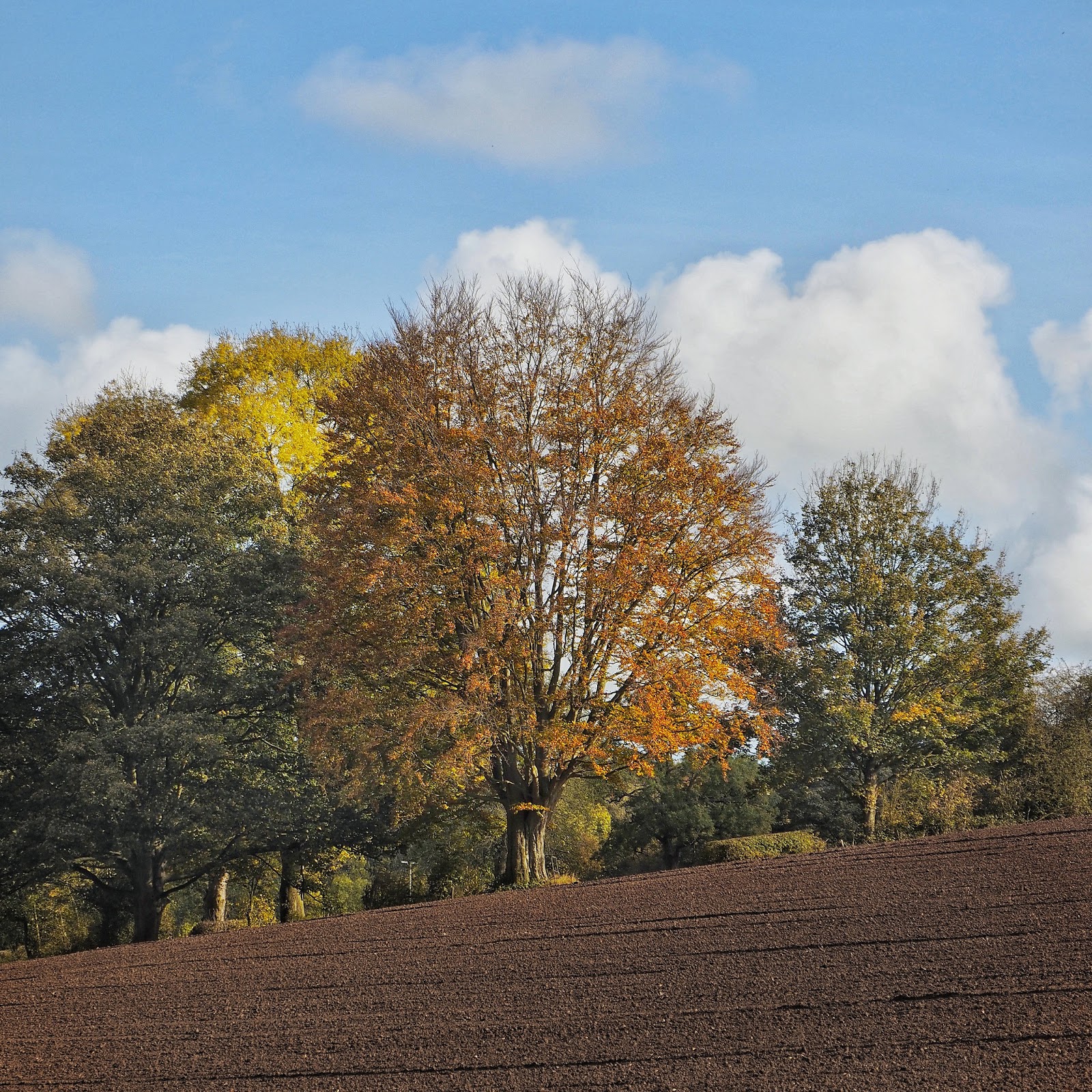
Surely even the most resolute townie can't look at the warm spectrum of colours in the UK's woods, hedgerows, parks and gardens at this time of year and not be moved, somewhere deep inside, to smile.

Is there any better type of day to explore the British countryside than a bright, crisp, autumn day where the chill of winter round the corner is tangible, but the memory of summers warmth on your back has yet to fade?

The vibrance of summer is gradually consumed by the slow-starting, but all encompassing fire of autumn until the trees and woods blaze into colour fore one last unified hurrah before dying with dignity, awaiting their phoenix like rebirth a few months ahead in spring. 

Even the difficult to love features of the countryside demonstrate a softer side, and become a little more lovable. Non-native, straight-lined, opinion-dividing blocks of commercial conifer forestry can look easier on the eye at this time of year. It depends on whether they contain some Larch, a conflicted species whose needles turn yellow-orange and fall, more like a deciduous species. Large, sprawling beds of bracken, the bane of upland land owners and managers turn a mottled, rusty brown which adds a subtle undertone to the last vestiges of the purple heather on the high moorlands.


I've been particularly lucky this year to have many opportunities to be out soaking in the autumn colours: all round the Peak District 'in the line of duty' for work, down in Riddy Wood on the handful of occasions I've been able to get there so far this season, and as a family we've taken the chance to get out and about.  We put in some effort and made quite a few opportunities - its not like they're difficult to find if you look for them - even your local canal towpath, city park or country lane holds coloured treasures not present at any other time of year.

Of course you can head further afield to make the most of it, and a few weeks ago we visited the Forest of Dean for the first time. It was fortuitous timing as much as anything that took us there at this time of years, and the good fortune favoured us again as we had a beautiful day to enjoy while we were there. The golden autumn colours were positively glowing, and we followed our children and their cousins (who we were visiting with) round the muddy paths, splashing in puddles, being fascinated by deer slots and wild boar rooting, and calling out the mushrooms which were making the most of the warm, humid woods and adding to the kaleidoscope of colour and texture on the woodland floor. It was great!

Did I mention that Autumn is my favourite season? I hope you're enjoying it as much as me! 

Richard


Tuesday, 7 November 2017

Finally made it to the Forest of Dean

We all have places we've wanted to visit or activities we've wanted to do 'forever'. Some of those wishes are realistic and others less so. For example, I'd love to go to New Zealand - and one day I might, but it won't be just yet. On the other hand, I've wanted to go to the Forest of Dean for a long time, and that is readily achievable, but I just haven't made the time or prioritised it over other opportunities.

But recently one of my brothers moved to Gloucestershire, right on the edge of the Forest of Dean. Last weekend we went to visit him and his family to get to see their new home and neighbourhood. It would have been a shame to miss out on a joint family walk, especially with the autumn colours at their best and the beautiful weather we had during our short stay.

One of the reasons I'd wanted to visit the Forest of Dean are the now infamous wild boar. I knew the boar themselves were likely to be illusive and didn't really hold out that much hope that we'd see one. But the evidence of their presence was certainly more conspicuous! The boars rooting around had turned the road verges over as effectively as the most diligent gardener. And then out of the blue and on route to our selected walking spot, there one was! As bold as brass rooting away right next to a public car park and attracting quite the crowd (including us). Having never seen a boar in England before it was quite the treat and the children enjoyed seeing the 'hairy piggy' too.

It had rained heavily overnight and the paths we walked were suitably muddy - muddy paths are always a bonus when you're walking with children. Even when, like our little lad, you often fall over in it. He spent a noticeable portion of our outing on his backside or face in the mud. We spent a happy couple of hours splashing in puddles, enjoying the autumn colours and foraging mushrooms for a late lunch (my brother is something of an expert so I feel comfortable picking them with him) before retracing our steps back to the car and heading home for a late lunch, bonfire and fireworks. Happy days!

The weather for our drive home through the midlands was as beautiful as the scenery and I was reminded yet again just what a beautiful country England is and how much we take our natural world for granted! We will continue to get our outdoors time as a family regardless of the cold and the mud as we get into Autumn and Winter.

Richard


Monday, 30 October 2017

Archive: Rivers - Supermarket, Highway, Inspiration

** I'm cheating a bit here - It's been a busy few weeks and I haven't had a chance to 
write any new blog posts, although there is stuff to write about! To keep material 
coming I thought I'd share this blog post from a blog I contribute to occasionally, 
originally written a few years back it is still as relevant now as when I wrote it. **

When I am out and about, whether it be for a gentle countryside walk with my family, a solo adventure, dedicated photography trip or a foraging session, I am always drawn to certain features in the landscape . Rivers are one of those features, particular smaller rivers in deep cut, wooded valleys. There is something about these valleys that never gets old to me. As a teenager on the North Devon coast I had plenty of opportunities to explore these sort of valleys, including in and around Exmoor, to this day one of my favourite parts of the UK. 

Me, contemplating life alongside the River Spey in Scotland.  
You may ask why, and I don't really know the definitive answer to that question but I have a few ideas. The first revolves around the concept of mental maps (something I had written about previously and will probably do so again for this blog), particularly resource maps. Rivers are a phenomenally rich resource (I originally wrote this for a bushcraft blog - www.bushcrafteducation.co.uk - and so it was originally aimed at foraging and that sort of topic):

First and foremost they are a readily available source of water. In the higher reaches of rivers where they run fast and clear it is also likely to be clean water which you can drink straight from the river. Even these days in areas where agricultural run off may have sullied the water, or in its lower reaches where it runs slow and silty, with simple techniques it can be filtered and purified to be made safe to drink.

They were to our hunter-gatherer ancestors an important source of protein, and still are today albeit one which is far less used than it once would have been, in the shape of water birds*, fish* and crayfish (although sadly these days an invasive species, the American Signal Crayfish which has driven our native White-clawed Crayfish to the edge of extinction). If you know where to look there may also be freshwater mussels or as you get closer to the coast and into the brackish and tidal zones of the river there may be other salt-water shellfish to harvest. 

With a constant source of water and, further down the river at least, nutrient rich silts, river valleys are often a great source of plant food as well. To name a few, wetland areas associated with rivers are often home to sedges (Carex spp.), some of which have seeds which can be eaten; Bulrush or Greater Reedmace (Typha latifolia) can be found which has edible rhizomes as well as being a useful tinder. These days in the UK several very common edible plants found along rivers are non-native species, certainly not something our hunter-gatherer forebears would have been familiar with - Himalayan Balsam (Impatiens glandulifera) and Japanese Knotweed (Fallopia japonica). And by eating either of these you are also doing your bit for conservation by reducing the population of an invasive plant. 

Some of the trees often found in close association with water are Willow species. Willow is an extremely useful plant to a bushcrafter providing bark for cordage & withies for basket making. In addition its bark contains Salicylic acid (in fact 'Salicylic' is derived from Salix, the Latin name for the Willow family) which is a component of aspirin and it has been known for centuries that chewing on willow bark could ease aches and pains and reduce fevers. 

Having established that rivers are useful for resources I think that part of my fondness for rivers stems from an instinctive draw to a landscape feature which is of use to me. But I don't think that's the whole story. 
Rivers are also beneficial for moving through the landscape. In a very modern sense we can see this based on how many roads or railway lines follow the course of rivers. In many circumstances the river bed itself will be the path through a landscape which experiences the least severe changes in elevation - waterfalls being a fairly obvious exception! By following these ready made paths modern engineers have saved themselves time and effort but also created for themselves different issues by placing their projects in the path of an immense erosive power - but that's another story.

I don't think this benefit would have been unappreciated by the people who roamed the land when roads weren't even a futuristic dream. Especially during the summer, when vegetation was at its highest and most impenetrable, and the water level was lower likely exposing a portion of the river bed, using these natural routes to move inland from the coast or the opposite would have saved effort and ensured that food to fuel your travels was never far away. Certainly in dense woodland I have followed small rivers or streams, sometimes alongside them and sometimes by necessity in them to aid my movements and help me to move more quickly or easily. It has long been a goal of mine to follow a river from its source to the sea - I think it would be a fascinating journey! 

In all this I have skirted around the potential of travel on the water itself. While not a expert in water travel I have been lucky enough to do a bit of kayaking and rafting both on rivers and the sea and it is a great way to travel. Early inhabitants of the UK may not have cashed in on this opportunity as much as those in other parts of the world, the effort required to manufacture water-borne vessels perhaps outweighing the advantages in many situations on a relatively small island. It is however well documented that early civilisations in other parts of the world focused their travel on waterways with variations on the theme of dug out canoes and later in the northern hemisphere with bark canoes. 

If you are referring back to the title you'll notice we are two thirds of the way through this tale. There will be those who read 'inspiration' in relation to 'river' and think I have lost it - city folks perhaps for whom rivers are places for stolen bikes and shopping trolleys, pollution outflows and perhaps if your lucky, the odd gull or duck. Luckily in Britain today even this inner city image of rivers is largely a thing of the past with tighter controls on pollution and water cleanliness but still the Thames in London or the Mersey in Liverpool are not the sort of rivers I look to for inspiration. 

The picture that comes to my mind when I think of inspiring rivers is a small river, wooded valley sides rising steeply above, clear water trickling quickly through a jumble of moss-covered rocks and woody debris. A Dipper rushing past or watching you from a half-submerged rock. Perhaps a little further downstream a whistle and a flash of blue alerting you to what has got to be the UK's most colourful bird, the Kingfisher, going about its business. If you're lucky some muddy footprints indicate a Otter isn't far away, and if your even luckier a glimpse of these now thankfully returning mammals. In the early morning mist a Roe deer perhaps, tentatively crossing from its shelter on one side to prime feeding ground on the other. As the sun gets higher, the dragonflies, the birds of prey of the insect world start to come to life. I could watch their aerial battles for territory and bright colours for hours before I got even a little bit bored. At the right time of year mayflies provide a spectacle, both as they 'dance' above the water and as they are fed on by every valley dweller you can imagine. I could go on... so I shall.

As a teenager I was lucky enough to work on a nature reserve for a week in Scotland. (On a side note, to any young person reading this, I cannot recommend highly enough this experience.) One day having been to check a hide over looking a large marshy flood plain alongside the river Spey, I spotted a family of fox cubs playing on a 'island' in the marsh, their earth was obviously located on the slightly higher and therefore drier ground above the wetland, among the gorse. On my return journey to my accommodation that evening, a gorgeous summer evening, I cut across the reserve - cresting a ridge having climbed up steeply through birch woodland I looked up to see an Osprey flying over, fish held tightly in its talons. Standing on the ridge transfixed by this spectacle I had never witnessed before I became aware of movement in the valley meadow below - a Roe buck, summer coat radiant red in the low evening sun had moved out of the woodland to browse. What a day! Not all strictly river associated but all within a stones throw.

The view from the hide I mention. The 'island' where I saw the foxes is in the middle ground on the left, the meadow where I saw the Roebuck a mile or so up the valley to the North (right in this picture). I have also seen Roe deer browsing through the marshland here - one doe in particular was selecting only umbellifer flower heads to eat, the only time I have seen this behaviour and a perfect example of the selective feeding style of Roe Deer. 
I know of no sound more relaxing and calming than the gentle trickle of a river to lull me off to sleep in an evening after a strenuous day out of doors. And in the same way I could sit, and have done on many occasions, and stare at a fire burning for hours, I could sit and watch a river flowing past, listening to its gurgles and trickles just as I listen to the pops and crackles of my fire. With the calls of Kingfishers or Dippers replacing the Tawny Owls I so often hear when sat by a fire in woodland.  

Beyond the river itself the landscapes they have created can be awe inspiring all on their own, dramatic landscapes all over the UK have been carved over many millennia by the rivers which now seem like a side show in the valley bottom. Caves and tunnels, stacks and caves and water falls all indicate the sheer power of water in the landscape and can be as spectacular as their coastal counterparts. 

We all I dare say have 'favourite landscapes' - I would certainly have to say that rivers and the associated valleys and wetlands are well up there for me. They provide food and fun, mental relaxation and the ability to move through the landscapes we love. What's not to like!

Richard


* - It needs to be remembered that the taking of certain fish and all water birds, and the methods of taking or catching them are restricted by law in the UK. In certain circumstances you may just need landowners permission, in other it is far more complicated.