Showing posts with label Coast. Show all posts

Monday, 2 September 2019

Meteors & Lighthouses

My one meteor photograph of the morning... room for improvement!
It's late on a freezing December night in the mid 1990's. A young boy and his dad give up trying to put up their tent at a friends farm in rural Wales. The ground is frozen solid - without a hammer there is no way they are getting those pegs in the ground. The alternative is the car, which seems like a poor option at first. Wrapped up in all his clothes and his sleeping bag the boy reclines in the passenger seat and hopes he will be able to sleep. But soon sleep is the last thing on his mind because the sky is falling!

Little did my dad and I know all those years ago that by pure chance we had picked the peak of the Geminids meteor shower for our winter camping excursion. The frosty temperatures resulted from a perfectly clear night which revealed a stunningly starry sky. As we relaxed - well, settled at least - into our cold but well windowed accommodation we realised that the 'stars' were a whole lot more active than usual. Meteors were falling, by the hundred. Or so it seemed to my little boys imagination nearly a quarter of a century ago (wow, I am getting old!). 

-------- 

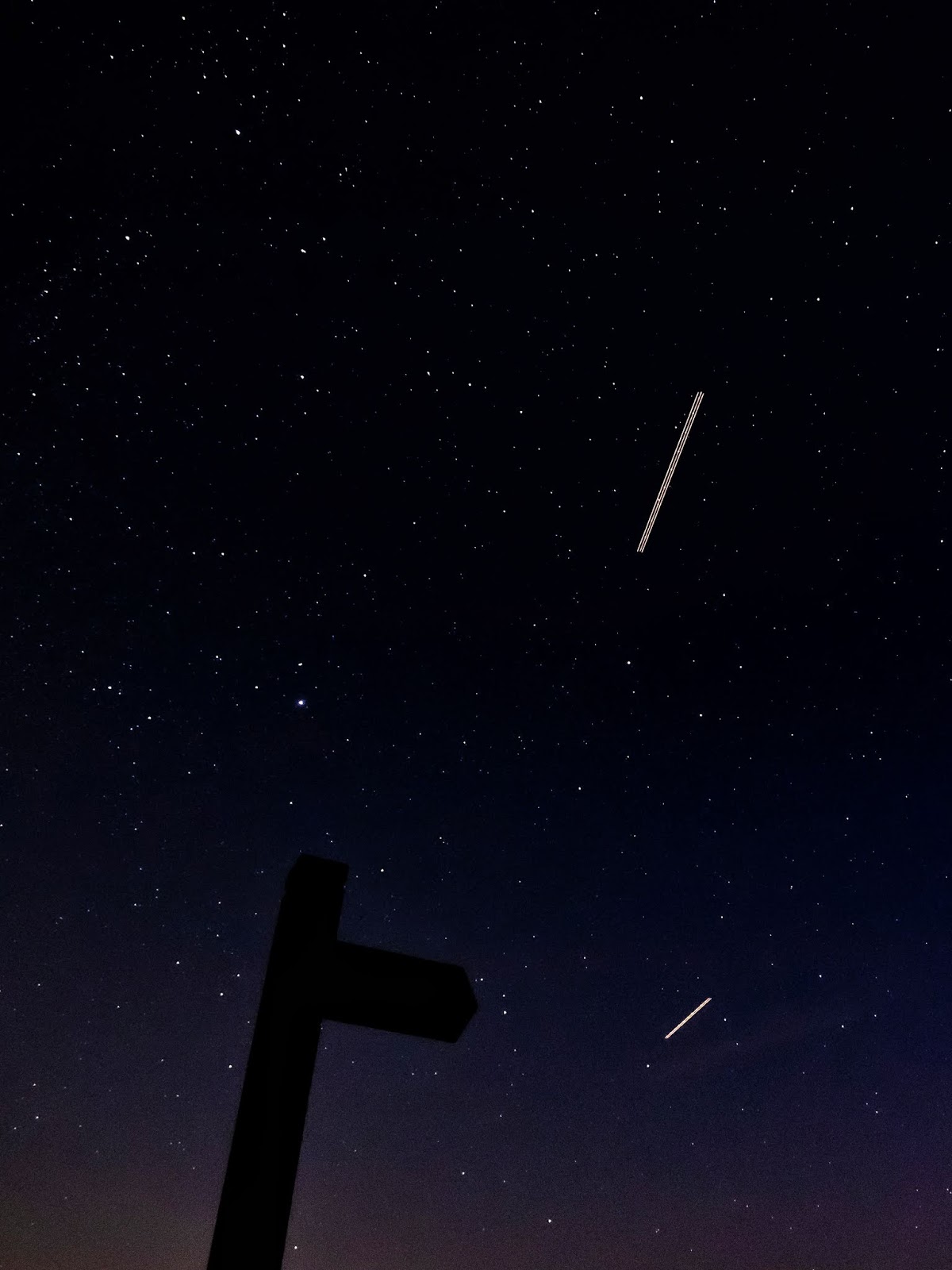
Not meteors, but the planes still look pretty
cool in photos! 
As a result of that experience as a youngster, the chance to watch a meteor shower will always grab my attention. I even took my girlfriend to watch the Perseids shower as one of our first dates just over 10 years ago... given that she has now been my wife for 9 years that worked out pretty well. 

Knowing that this year the peak of the Perseids meteor shower coincided with a break to visit family in rural Suffolk, where light pollution is less of a concern than urban Stoke (who'd have guessed it?!) we planned to try and watch the shooting stars again, this time sharing them with our children. That was the plan anyway. The night before the peak we sat out in the back garden for a few minutes and caught sight of a handful of meteors before retiring for bed, keeping our fingers crossed that the forecast of clear skies the following night would hold true. 

The next night the alarm was set for 2:15 am. Thank goodness I don't do that too often! I got up to check the skies were clear and then returned to help my wife wake up the children... except they would not be woken! Our 7 year old rolled over, pulled the covers over her head and told us to go away. The 3 year old didn't even stir despite extended shaking and repeatedly calling his name. Oh well, maybe next time.

The first of the dawn light competing with the last of
the stars. 
Laid on camping mats in the garden to take in as much of the sky as possible, we watched the 'show' for a while - the best kind of outdoor theatre. We probably saw a dozen or so in the 20 minutes we watched for, but the light spilling over from surrounding houses marred it a little. Emily very sensibly returned to a warm and comfy bed but I, sucker for punishment that I am, wanted to make a little more of the opportunity. I drove the 10 minutes out to the coast where I hoped there would be less light pollution to watch for a bit longer. It was worth the drive!

I also wanted to try to take some photo's, hoping to catch a shooting star or two. My previous attempts at astrophotography have been amateurish at best, and I didn't think these would be much better, but you've got to start somewhere. I set the camera up and took some test shots then set the camera running taking continuous shots hoping that a meteor would coincide with one of the images. The results were not great, but it was a chance to practice the technique at least. I caught one shooting star, a tiny smudge of a meteor - I think I picked the wrong bit of sky to point the camera at. Never mind, lessons learned. 

While laying on the ground looking up at the sky listening to the camera shutter repeatedly opening and closing, I became aware that the footpath sign just beyond my feet had changed shape. Confused and assuming I had dozed off and that my eyes were playing tricks on me, I stared harder at the sign. It moved. It took me another second or two to realise that the new shape was that of a Barn Owl which must have silently alighted while my gaze was directed elsewhere. It sat for a moment before going on its way with scarcely a sound - I think it heard me shift position for a better view. Having an owl, or any other wild animal for that matter, approach to within 10 feet of you is a pretty good way to start any day. And my day really was only just starting, it still wasn't even 5 am at this point!

I probably saw another 30 or so meteors before dawn started to colour and brighten the eastern sky, fading the stars until only the very brightest were still visible. Given my location on the east coast it would have been rude not to hang around for a bit longer to watch the sun rise out of the North Sea, a sight I don't get to enjoy all too often. I wandered north along the shingle for a few minutes until Orford Ness Lighthouse was more or less in line with where the sun would rise and waited. I figured the lighthouse would be a worthwhile addition to any photo's I may take. While completely alone, I was not without company. Hundreds of sea birds were waking up and flying off. Many of them had clearly roosted in the safety offered by the single spit of Orford Ness. The fisherman were up too - several trawlers chugged past me heading for deeper waters and pushing a wave after wave along the shore as I waited, each peeling off a cloud of gulls as it passed.

With half an hour or more until the sun was due to rise I played about with a few time lapses of the rolling clouds and brightening sky until the sun poked out from behind a large cloud on the distant horizon. It wasn't the most dramatic sunrise I've ever seen, but there is something about being witness to the birth of a new day which never gets old. Heading back towards the car, there was a lot more light to see what I had unwittingly passed earlier. Brown hares and curlews sat in the pastures reclaimed from the surrounding salt marsh. Reed buntings and other small birds sat atop the swaying reeds which lined the ditches. A lone seal, lounging on the shingle, stirred lazily as the day brightened, clearly contemplating the right moment to go in search of breakfast. I had been making a similar decision and was hoping that I'd be back in time to grab not only breakfast, but also 40 winks before the rest of the household woke up too!


Richard


The first peek of the sun rising behind the Orford Ness light house. 


Saturday, 30 December 2017

'The Best Books' - Robert McFarlane: The Wild Places


Reading is a luxury I don't get in large quantities these days - work, family, church, part time work (glorified hobbies), photography - they all take their chunk of time. As a kid I used to read loads and when we first got married, before I started University, we both used to read loads together - probably because we couldn't afford to do much else! These days what would have been my typical reading time - the period between going to bed and falling asleep - is often so short that reading the blurb in one go would be a struggle.

Anyway - that slightly off topic waffle goes to explain why it took me nearly two years to finish reading this book, but it was certainly worth persevering!


I'd been aware of Robert Macfarlane as an author for a while but not had an opportunity to read any of his books until a few years ago when I requested a few for a Christmas present (or Birthday... I can't actually remember!). Thereafter I started reading it in fits and spurts as time allowed, which often meant while I was away from home on trips - working in the woods, holidays visiting family and so on - when the normal routines which fill up your day were disrupted enough to free up a bit of time in the day. These are also the times when I am most likely to be able to spare some time for adventure, exploration and time spent out of doors in the peace that the natural world provides, either as a family or occasionally solo. 

And this is the core of the 'The Wild Places' narrative. It is certainly something that resonates with me - an exploration of the last places in the UK which can still be considered as wild, what an adventure! I'm lucky enough to be familiar with a few of the places he visited in the writing of the book. I even read the chapter about coastal wildness - which recounts a visit to Orfordness on the Suffolk coast - the night after a micro-adventure of my own in that area. My in-laws live just a few miles from Shingle Street, the little hamlet where the spit fades away and joins the North Sea. My brother in law had recently acquired a set of inflatable canoes and had been looking for a chance to try them out. Being mid-summer we made the most of the long evening and stole away for a few hours to try the new toys. The sunset canoe expedition which followed is a fond memory which I have written about before and took us up river toward Orford flanked by Orfordness to the East and the salt marsh on our landward side. We stopped briefly on the shingle to enjoy the views before heading back to our start point... a journey made far more difficult by the tide which had turned and was now racing in. We ended up walking back to the car, beaten by the speed of the inbound tide which rendered our inexperienced paddling completely useless as we struggled to not be drawn back inland, let alone making significant forward progress!

Suffolk was among the tamer landscapes and habitats described. Trips to islands, far flung, dune clad coastlines, limestone pavements and the hidden world within there shaded grykes, windswept moorland, barren mountains tops and snow covered bogs with the shadow of ancient woodland are all described in a detail which simultaneously transports you there in person while instilling a burning desire to make a similar pilgrimage to such places yourself . Ever since reading about a night Macfarlane spent on top of Ben Hope near the north coast of Scotland I have been trying to find a reason to justify the 1000 mile round trip to see it for myself. I haven't found a reason yet... but it isn't going anywhere, I'll figure it out someday. 

Of course his trip to the Hope Valley in Derbyshire to look for mountain hares is something I can recreate far more simply - given that my office is in the valley next door! That's not to belittle the experience, I still love to see the white hares bounding away, particularly when there is snow on the ground. So far this year I have been tied up with office work and haven't been up on the hills yet to see them in their winter coats. Luckily there is certainly good opportunity for me to do so in the new year and I'll be sure the make the most of it! It is easy to forgot - working there everyday - that to so many people in the UK coming to the Peak District is a way to escape the daily grind of work, whereas for me, it is work. 

The picture at the top of the page was taken while on a short trip of my own - I was on route to watch a rugby game in Cardiff with my family. Having spent many of my formative childhood years in Wales I made the most of the opportunity by travelling down through Wales revisiting old haunts. In the evening I travelled to the end of the Gower Peninsula on the south coast of Wales to watch the sun go down over Worms Head. It wasn't long after I had acquired my new camera and I attempted to capture the scene with a time lapse... it wasn't the greatest success (you can watch it here if you really want!), but it gave me an hour on a wild coastline to sit in beautiful surroundings and read about Macfarlane making a trip to a comparable coastline a few hundred miles north, only he was approaching from the sea.

I won't go on - discussions of this nature get my mind racing through the long list of places I'd like to visit. And while patience is certainly a virtue it's not one I'm blessed with in abundance. There is a real risk I will lay awake at night dreaming of the Cairngorms, or the Outer Hebrides, or the wild rivers of mid-wales where I swam as a child, or the rugged coastline of Devon where I camped as a teenager... you see what I mean!? Much like 'The Wild Places', my list of dream destinations are largely in the UK. We are blessed with such a diverse island, or series of islands, that international travel isn't necessary if you goal is to visit wild places. If you're struggling for ideas then reading 'The Wild Places' will certainly give you food for thought, in fact it will be a feast! 

Follow Robert Macfarlane on:
Twitter:       @RobGMacfarlane
Instagram:   @robgmacfarlane

Alternatively have a look at all of his books here at his Amazon author profile.


Monday, 30 October 2017

Archive: Rivers - Supermarket, Highway, Inspiration

** I'm cheating a bit here - It's been a busy few weeks and I haven't had a chance to 
write any new blog posts, although there is stuff to write about! To keep material 
coming I thought I'd share this blog post from a blog I contribute to occasionally, 
originally written a few years back it is still as relevant now as when I wrote it. **

When I am out and about, whether it be for a gentle countryside walk with my family, a solo adventure, dedicated photography trip or a foraging session, I am always drawn to certain features in the landscape . Rivers are one of those features, particular smaller rivers in deep cut, wooded valleys. There is something about these valleys that never gets old to me. As a teenager on the North Devon coast I had plenty of opportunities to explore these sort of valleys, including in and around Exmoor, to this day one of my favourite parts of the UK. 

Me, contemplating life alongside the River Spey in Scotland.  
You may ask why, and I don't really know the definitive answer to that question but I have a few ideas. The first revolves around the concept of mental maps (something I had written about previously and will probably do so again for this blog), particularly resource maps. Rivers are a phenomenally rich resource (I originally wrote this for a bushcraft blog - www.bushcrafteducation.co.uk - and so it was originally aimed at foraging and that sort of topic):

First and foremost they are a readily available source of water. In the higher reaches of rivers where they run fast and clear it is also likely to be clean water which you can drink straight from the river. Even these days in areas where agricultural run off may have sullied the water, or in its lower reaches where it runs slow and silty, with simple techniques it can be filtered and purified to be made safe to drink.

They were to our hunter-gatherer ancestors an important source of protein, and still are today albeit one which is far less used than it once would have been, in the shape of water birds*, fish* and crayfish (although sadly these days an invasive species, the American Signal Crayfish which has driven our native White-clawed Crayfish to the edge of extinction). If you know where to look there may also be freshwater mussels or as you get closer to the coast and into the brackish and tidal zones of the river there may be other salt-water shellfish to harvest. 

With a constant source of water and, further down the river at least, nutrient rich silts, river valleys are often a great source of plant food as well. To name a few, wetland areas associated with rivers are often home to sedges (Carex spp.), some of which have seeds which can be eaten; Bulrush or Greater Reedmace (Typha latifolia) can be found which has edible rhizomes as well as being a useful tinder. These days in the UK several very common edible plants found along rivers are non-native species, certainly not something our hunter-gatherer forebears would have been familiar with - Himalayan Balsam (Impatiens glandulifera) and Japanese Knotweed (Fallopia japonica). And by eating either of these you are also doing your bit for conservation by reducing the population of an invasive plant. 

Some of the trees often found in close association with water are Willow species. Willow is an extremely useful plant to a bushcrafter providing bark for cordage & withies for basket making. In addition its bark contains Salicylic acid (in fact 'Salicylic' is derived from Salix, the Latin name for the Willow family) which is a component of aspirin and it has been known for centuries that chewing on willow bark could ease aches and pains and reduce fevers. 

Having established that rivers are useful for resources I think that part of my fondness for rivers stems from an instinctive draw to a landscape feature which is of use to me. But I don't think that's the whole story. 
Rivers are also beneficial for moving through the landscape. In a very modern sense we can see this based on how many roads or railway lines follow the course of rivers. In many circumstances the river bed itself will be the path through a landscape which experiences the least severe changes in elevation - waterfalls being a fairly obvious exception! By following these ready made paths modern engineers have saved themselves time and effort but also created for themselves different issues by placing their projects in the path of an immense erosive power - but that's another story.

I don't think this benefit would have been unappreciated by the people who roamed the land when roads weren't even a futuristic dream. Especially during the summer, when vegetation was at its highest and most impenetrable, and the water level was lower likely exposing a portion of the river bed, using these natural routes to move inland from the coast or the opposite would have saved effort and ensured that food to fuel your travels was never far away. Certainly in dense woodland I have followed small rivers or streams, sometimes alongside them and sometimes by necessity in them to aid my movements and help me to move more quickly or easily. It has long been a goal of mine to follow a river from its source to the sea - I think it would be a fascinating journey! 

In all this I have skirted around the potential of travel on the water itself. While not a expert in water travel I have been lucky enough to do a bit of kayaking and rafting both on rivers and the sea and it is a great way to travel. Early inhabitants of the UK may not have cashed in on this opportunity as much as those in other parts of the world, the effort required to manufacture water-borne vessels perhaps outweighing the advantages in many situations on a relatively small island. It is however well documented that early civilisations in other parts of the world focused their travel on waterways with variations on the theme of dug out canoes and later in the northern hemisphere with bark canoes. 

If you are referring back to the title you'll notice we are two thirds of the way through this tale. There will be those who read 'inspiration' in relation to 'river' and think I have lost it - city folks perhaps for whom rivers are places for stolen bikes and shopping trolleys, pollution outflows and perhaps if your lucky, the odd gull or duck. Luckily in Britain today even this inner city image of rivers is largely a thing of the past with tighter controls on pollution and water cleanliness but still the Thames in London or the Mersey in Liverpool are not the sort of rivers I look to for inspiration. 

The picture that comes to my mind when I think of inspiring rivers is a small river, wooded valley sides rising steeply above, clear water trickling quickly through a jumble of moss-covered rocks and woody debris. A Dipper rushing past or watching you from a half-submerged rock. Perhaps a little further downstream a whistle and a flash of blue alerting you to what has got to be the UK's most colourful bird, the Kingfisher, going about its business. If you're lucky some muddy footprints indicate a Otter isn't far away, and if your even luckier a glimpse of these now thankfully returning mammals. In the early morning mist a Roe deer perhaps, tentatively crossing from its shelter on one side to prime feeding ground on the other. As the sun gets higher, the dragonflies, the birds of prey of the insect world start to come to life. I could watch their aerial battles for territory and bright colours for hours before I got even a little bit bored. At the right time of year mayflies provide a spectacle, both as they 'dance' above the water and as they are fed on by every valley dweller you can imagine. I could go on... so I shall.

As a teenager I was lucky enough to work on a nature reserve for a week in Scotland. (On a side note, to any young person reading this, I cannot recommend highly enough this experience.) One day having been to check a hide over looking a large marshy flood plain alongside the river Spey, I spotted a family of fox cubs playing on a 'island' in the marsh, their earth was obviously located on the slightly higher and therefore drier ground above the wetland, among the gorse. On my return journey to my accommodation that evening, a gorgeous summer evening, I cut across the reserve - cresting a ridge having climbed up steeply through birch woodland I looked up to see an Osprey flying over, fish held tightly in its talons. Standing on the ridge transfixed by this spectacle I had never witnessed before I became aware of movement in the valley meadow below - a Roe buck, summer coat radiant red in the low evening sun had moved out of the woodland to browse. What a day! Not all strictly river associated but all within a stones throw.

The view from the hide I mention. The 'island' where I saw the foxes is in the middle ground on the left, the meadow where I saw the Roebuck a mile or so up the valley to the North (right in this picture). I have also seen Roe deer browsing through the marshland here - one doe in particular was selecting only umbellifer flower heads to eat, the only time I have seen this behaviour and a perfect example of the selective feeding style of Roe Deer. 
I know of no sound more relaxing and calming than the gentle trickle of a river to lull me off to sleep in an evening after a strenuous day out of doors. And in the same way I could sit, and have done on many occasions, and stare at a fire burning for hours, I could sit and watch a river flowing past, listening to its gurgles and trickles just as I listen to the pops and crackles of my fire. With the calls of Kingfishers or Dippers replacing the Tawny Owls I so often hear when sat by a fire in woodland.  

Beyond the river itself the landscapes they have created can be awe inspiring all on their own, dramatic landscapes all over the UK have been carved over many millennia by the rivers which now seem like a side show in the valley bottom. Caves and tunnels, stacks and caves and water falls all indicate the sheer power of water in the landscape and can be as spectacular as their coastal counterparts. 

We all I dare say have 'favourite landscapes' - I would certainly have to say that rivers and the associated valleys and wetlands are well up there for me. They provide food and fun, mental relaxation and the ability to move through the landscapes we love. What's not to like!

Richard


* - It needs to be remembered that the taking of certain fish and all water birds, and the methods of taking or catching them are restricted by law in the UK. In certain circumstances you may just need landowners permission, in other it is far more complicated. 

Sunday, 10 September 2017

Sunset Paddle

(**I've got a bit of catching up to do on these blog post subjects, this one's from early August**)

We hadn't intended to be paddling at sunset specifically, but we both really wanted to put our new toys to the test. It is my wife's fault really - in the best possible way - she started it at any rate. 

You see Emily brought me a canoe for Fathers day, a budget, inflatable one, but a canoe none the less, and it was, and still is, brilliant. (Proving the rule that 'You don't need to spend a lot of money to have a lot of fun!'). We had christened it with style, at a canoe slalom course not far from home. The children had loved it and I was beyond enthusiastic to be able to add a new dimension to future adventures - I've wanted something like this for a while. 

I'm no expert paddler, but I've played around with canoes / kayaks a few times and my limited skill was sufficient to generate almost limitless fun (in the children's eyes, and mine). Obviously this needed to feature highly in the upcoming summer holiday plans. When visiting my parents in the Fen's of Cambridgeshire it made an extended outing on the river near St Ives. During this trip it carried various members of my family and only capsized once - the accolade for that achievement goes to my Dad - love you Dad! 

Les heading for Europe!

The photo's from this trip leave something to be desired - I didn't have the guts to take my 'proper' camera out on the canoe in case something happened so I just took my phone in a plastic bag. What I need is a proper water-proof rugged camera. If Olympus UK are reading this I will happily accept a TG-5 or a Tracker or both to review on my next watery adventure. Just saying...

We then made the short hop across to the Suffolk coast where Emily's family live. And so, naturally, we put it out to sea, although not very far out. There was a stiff off-shore breeze and as I didn't have my passport with me I didn't fancy a trip across to the Netherlands! We spent an enjoyable hour or two with Megan enjoying her very first attempt at paddling. This wasn't the end of our water-based holiday fun though - at least not mine.

Megan and I come back to terra firma after an enjoyable paddle. 

In the run up to the holiday Emily's brother (Les) had also acquired a couple of inflatable canoes, but not had a chance to try them out before we came down for our visit. We put our heads together at a friends wedding and planned an outing for later that evening to have a micro-adventure of sorts. After various versions of a plan we settled on something a little more realistic than initially suggested (I was a possibly a bit too keen...) and a few hours later we met, threw my canoe in his van and drove the 10 mins to the tiny coastal hamlet of Shingle Street, at the pointy end of Orford Ness. 

We quickly got suited and booted, (more like 'buoyancy-aided and de-booted') and out onto the water. The off-shore breeze of the day before was gone and with it my reluctance to leave the shelter of the shingle bank. So we glided out onto a mill-pond smooth North Sea beneath a stunningly clear, blue evening sky. We paddled out to a buoy marking the safe entrance to the River Alde, which flows parallel to the sea but protected behind the fascinating natural barrier of Orford Ness. We pushed up river for a bit, following a yacht which left us far behind as it smoothly headed for the distant Orford Castle just visible up river. The going was slow but easy, with little if any perceivable current at this point, but the tide was turning.

Exploring the side channel on our way back with an amazing water colour sky. 

It was beautifully warm and calm. We cruised past wading birds foraging on the muddy shore and were over-flown by groups of others on route to an evening roost. This didn't come as much of a surprise of course as we were only a short way, as the Avocet flies, from the RSPB's Havergate Island Reserve. Having both visited the island reserve on an official tour, and been around it on a fishing boat out from Orford I would recommend a visit for anyone who enjoys a peaceful spot of wildlife watching.

Before we tucked behind the shingle spit of Orford Ness we had an uninterrupted ocean view to the east with nothing but a few distant boats to suggest the civilised world extended in that direction. Back to the west, out of sight over the bank stretched acres of salt-marsh, patiently waiting for the next inundation, then the fields, heathland and quiet villages which makes up the Suffolk Coast and Heaths Area of Outstanding Natural Beauty (AONB). On an evening like this it certainly lives up to its title! 

The sun was now getting properly low in the sky. Knowing that the tide would start coming in soon, and that we'd be paddling against it, we turned for home after a brief stop on 'the Ness' to re-inflate one of my canoes inflatable cells (it had decided to develop a slow leak). We hadn't gone far back towards our start point when the incoming tide really picked up the pace. I was very quickly reminded just how good canoeing can be as an arm workout! We weren't making much progress but with a stunning sky to watch it wasn't exactly a hardship. We weren't in any danger, apart from the embarrassment of a long walk!

In the hope of an easy escape we explored a side channel briefly, knowing that several of them took us back towards the car park, but quickly ran out of depth. Several Oyster Catchers watched us come, turn and go - having soft mud just beneath the surface of the water certainly wasn't an issue for them! In the end we dragged our canoes out and walked them back to the car along the shingle which gives Shingle Street its name (I assume). The combination of falling light and rising tide beat us fair and square, but what an evening. 

Beautiful weather + beautiful location + beautiful sunset + 
good company + good exercise = Excellent Adventure.  

Next time I think we'll plan to come down the river... with the tide!

Richard

P.S. - As it happens, there has already been a 'next time', albeit on a different river. That's the issue with being tardy at blog writing, that account will have to wait for another day.


Thursday, 1 June 2017

Nearly a wash out... : Family Adventure #2

Based on the weather during our 125 mile drive we were expecting to get wet! And when I say wet, I mean drowned-cat drenched. It poured most of the way. The coastal hills of North Wales were shrouded in a soggy blanket which was being consistently and vigorously wrung out as we progressed toward Anglesey.  

Nevertheless we had set out to have a family adventure, we were prepared for what the weather could throw at us (reasonably) and we were going anyway. We needn't have worried. By the time we got to the RSPB's South Stack reserve near Holyhead the rain had stopped, the cloud had lifted (although not cleared) and the temperature had risen to the point where shorts and t-shirts were a realistic proposition. We enjoyed an hour or two viewing the sea bird colonies and beautiful coastal landscapes at South Stack. Razorbills and Guillemots aplenty garnished with a few Puffins, Choughs and Rock Pipits. Did I mention that the water looked stunning! A gorgeous blue-green which while not exactly crystal clear still revealed enough of the secrets beneath the surface to make me more jealous than I am willing to admit of the people who came past on a speed boat tour!

My 5 year old daughter gleefully pointed out the similarity between the flocks of black and white sea birds jostling on the ludicrously cramped, guano-stained cliff ledges and the penguins that she has enjoyed watching on documentaries like Frozen Planet. It was great to see her enthusiasm, even when the best views were granted by descending goodness knows how many steps towards the lighthouse, and then reascending the same steps. Luckily I have discovered that all it takes to get a 5 year old upstairs quickly is to make it a race.

Moving on from South Stack we went to meet a friend who was very kindly putting us up for the night and then went to the beach with her and her children. Newborough is a lovely stretch of sand trapped against the shore by a swathe of forest frequented by Red Squirrels (although we didn't see any this time sadly). It was still grey and dull but warm enough for a paddle - my little boy (1 1/2 years old) was straight into the water and after the initial consternation that the water was a) moving and b) colder than his baths, he loved it! 
The tide was going out while we were there and a small flock of Oyster Catchers gathered awaiting the banquet which was about to be revealed. As interested as they were in the food being unveiled they allowed me to get quite close and photograph them foraging on the shingle banks. A very enjoyable 30 minutes or so - they are such characterful, colourful birds!

The next day before heading for home we headed to the shore of the nearby Menai Straits for a bit of beach combing, crab wrangling and slipping over on seaweed. I miss the coast - as a teenager I lived in North Devon, just a 10 minute drive or so from the coast - snorkelling during the summer months was a regular and favourite pastime, rock pooling was a family favourite too. The local coast lent itself perfectly to nights under the stars with a drift wood camp fire and the gentle swell of the tide and the rumble of pebbles to lull you gently off to sleep.
Now I am reaching the point where I can introduce my own children to the excitement of anticipating what might be found by lifting a rock on a shoreline - and hopefully in the not too distant future, by diving down to the sea floor - is a great feeling, even if it does remind me how old I am getting! 

Hope you enjoyed a brief account of a very enjoyable few days - there will be many more of these family adventures in the natural world to come! We all heartily recommend Anglesey as a family holiday destination, particularly for the outdoorsy, nature watching, adventuring types - we will certainly go again! 

Richard