Thursday, 8 March 2018

Wild Moments: The precious privilege of cultivating the spirit of adventure in a young heart.


** Another 'Wild Moment' considering something close to my heart - family, children and introducing them to the natural world and adventure **

Life is busy, isn't it? I'm sure it's not just mine. Commitments pile up, calendars fill and free time dwindles at an ever increasing pace. I often talk of needing to 'make' time and it sometimes does feel like a significant project to engineer opportunities for time out of doors, or for 'an adventure'. Adding children to that mix doesn't make it easier (or cheaper) - 'bed time' is suddenly 4 or 5 hours earlier; a 'good nights sleep' becomes an exception rather than an expectation; a 'walk' with a toddler can be considered long if you leave the car park rather than the county!

BUT - and it is a big one - as a parent you have an opportunity to plant the spirit of adventure in a fresh heart, and to see the excited twinkle of exploration in new eyes. I have always loved the outdoors, I still do, and I am fairly confident that I always will. I still enjoy spending that time in the natural world alone and at my own pace (which I like to think is reasonably quick... unless I'm taking photos). But there are very few things I enjoy more than witnessing the excitement in the eyes of our children when they are presented with the opportunity to do something new, something adventurous! Adventurous to them is at a different place on the spectrum than it is for me, of course it is. After all every one starts somewhere - Sir Edmund Hilary didn't start with Everest, nor was Amelia Earhart's first flight an around the world venture. *Add your favourite example of an intrepid adventurer here*. 

As parents we have tried (there is still a lot we could do better) to cultivate that adventurous spirit in our children because we hope that if we start them young that it will sink deep and they will seek 'adventure' for the rest of their lives. Yes, there are times when this meets with resistance: 'it's too cold', 'it's too wet', 'it's too windy', 'it's too sandy'. But that resistance will weaken over time. Our daughter once spent a whole warm, summer day on the beach sat in a folding chair with her feet on a towel because she refused point blank to get sand on her feet! The following year we visited a Scottish beach in April (it was much colder!) and she loved it! She played in it, rolled down sand dunes, dug holes and jumped in them - when we got back to where we were staying there was sand everywhere. Stick with it and the resistance will fade.

I was 24 when our daughter was born - that is pretty young these days to have a first child and I often have conversations where the reaction to learning this (sometimes spoken and sometimes inferred) is that my opportunities for fun therefore ended at 24. But I see it entirely differently. The way I see it is that when she becomes a teenager I'll still only be 37 (and 40 when our little boy becomes a teenager). Hopefully I will still be fit enough at that relatively young age that I will still be able to keep up with them when they take that spirit of adventure which we have instilled in them and want to do something really interesting!


So yes we may have sacrificed some of our perceived freedom as young adults to have a family early. But to me, rather than missing opportunities for fun and adventure, we have created the opportunity further down the road to share our fun and adventure with the people who matter most to us - our children.


Sunday, 11 February 2018

Snowdon - at last.

Oh no! The alarm hadn't gone off - I'd overslept!

Except I hadn't. I'd just dreamt that I had. This recurring (and very irritating) dream plagues my sleep whenever I have something exciting or important to look forward to the next day. And I certainly had something to look forward to. Even the thought of a 3:30am wake up and a long drive were not enough to dampen my spirits.

I dragged myself out of bed after what felt like a woefully inadequate sleep; that dream has a lot to answer for! My kit was all packed and stacked ready to go. After well over a decade of procrastination I was finally heading to Snowdon.

Having double-checked and loaded my kit, I left home and headed west for the Welsh border. On my drive I listened to the audio book of that classic tale of British wilderness (albeit Scottish rather than Welsh wilderness) 'The 39 Steps' by John Buchan. The sky was bright with a nearly full moon, although I knew that clouds were forecast to be my fate as my journey progressed.

Sure enough shortly after I crossed into the land of the Red Dragon the clouds blocked the moon as completely as if I had driven into a cave, limiting my view of the wider world to the reach of my headlights for the remainder of the trip. I made good time across Wales - at that time of morning traffic isn't exactly heavy - and arrived at Pen-y-Pass car park and the proper start of my days adventure at about 6:30am.

Here I listed my spare kidney on Ebay to fund the parking charges, donned my warm clothes and a head torch and rechecked the map of my route. When I initially started planning for my trip to Snowdon I had hoped to complete it in milder weather and follow the Snowdon Horseshoe route, along two precarious ridge lines up to and back down from the summit. When I learned that there was sure to be snow on the higher ground, and that I would need to start my ascent in the dark because of when I needed to get home, I shelved that plan for a later day. The revised plan was to get as far into the ascent as possible as quick as possible in case there was a sunrise worth photographing. So I settled on the broad and well surfaced Miners track and started on up.

The thick cloud still obscured the moon, and sunrise was still over an hour away so I began in total darkness with no view ahead, but I knew that the mountains towered ahead of me. Soon a few chinks opened in the cloud letting through the first hints of dawn and giving me enough visibility that I could turn off my torch. As my eyes adjusted to the new, lesser darkness I could make out a snow capped outline ahead of me! I assumed this was Snowdon and smiled to myself, my goal was in sight - I was wrong though. What I could see was just a part of the ridge, some 300m below the still cloud bound summit.


The Miners track is straight forward and easy going until the far side of Llyn Llydaw where it gets a little steeper and rougher, but it is above Glaslyn that the path, and the view, starts to get really interesting. This is about 2/3 of the linear distance into the route, but only 1/3 of the vertical ascent, leaving a steep route to negotiate over the last few kilometres. It was also around this point that the laying snow became persistent and the rising sun started to break through a chink in the low hanging clouds. The combination of cool blue lake, majestic snowy mountains, broken cloud and warm sunlight made for a breath taking view!

But the concept of 'a view' was about to become irrelevant. The laying snow and the lowering cloud merged into a wall of white before me. I lost the route of the path in the snow several times and struggled to gauge how much further I had to go. I couldn't see the track 30 meters ahead at times, let alone the summit. The wind driven snow had done a comprehensive job of smoothing out the hill side, blending series of steps into smooth icy slopes. With the aid of poles and studded snow walking aids (proper crampons don't feature on my kit list yet) I made it to the summit ridge feeling in my inexperience as close to a proper alpinist as I've come yet, with just a short walk along the ridge remaining to arrive at the actual summit.


The ridge looked alien! The frigid temperatures and driving winds over the preceding days had sculpted icy feathers over every inch of it. Snow remained only in the most sheltered of spots, the rest blasted off by howling winds. The swirling ice traced the eddies of the wind as clearly as smoke in a wind tunnel and coated the entire landscape, with only the dark rocks beneath breaking the white of the ice. The now brightening cloud still firmly clamped on top of the mountain cast a flat, contrast-less light uniformly over the ice-coated everything and created conditions unlike anything I have seen before - a completely monochrome landscape.

The summit cairn and trig point looked like a chaotically iced wedding cake, and the deserted train station like a movie set from 'The Day After Tomorrow'. I was the first to the top that morning - no one else had been crazy enough to start out for the summit as early as me - and the solitude was palpable, although short lived. A trio of walkers had been gradually catching me for the past hour while I kept stopping to take pictures and they arrived just a few minutes later. I'd like to think that pioneering a path through the fresh, unsullied snow for them had slowed me down, but the reality is almost certainly just that they were faster than me!


I didn't stay long at the top. I had made my pilgrimage, had my adventure. Call me anti-social but sharing these special places with throngs of other people spoils it for me. More often than not it is the solitude itself that I am seeking, and the personal challenge of completing the ascent in the first place, the views are a bonus, but a very welcome one when they are there! Sure enough I passed many other hikers toiling upwards while I descended, but even when the cloud lifted and the iced-gem summit appeared against a bright patch of blue I didn't envy them, because they had to share it, and I had had it to myself, if only for a few minutes.

Now that the clouds had lifted and the sun was properly up the views on my trek back down were every bit as stunning as you would expect of the Snowdonian Mountains in winter. Snow capped peaks were there to be seen in every direction and the low winter sun picked out the finest of topographical details in a landscape which begs the question why we Brits ever feel the need to travel abroad to see beautiful scenery. I made it down about 5 hours after I originally left the car. I shed my cold weather kit, now feeling distinctly over dressed among gaggles of children and young couples who at midday were only just arriving. I left quickly, keen now my adventure was over to get back to my family for the remainder of the day. A few miles away I had to stop and take in the view behind one more time. The clouds had now lifted fully and the snowy summit of Snowdon had revealed herself to all the world. It was the perfect parting memory, one that is certain to bring me back again soon. This may have been my first visit to Snowdon, but it won't be my last!


Richard

Saturday, 27 January 2018

The Best Books: Rob Penn - The Man who made things out of trees

I think anyone likely to be reading this will have gathered by now that I love the natural world. For the avoidance of doubt: I LOVE it! Everything about it.

Not just being in it and watching it (although that has to come top of the list), but reading about it, learning about it, photographing it, conserving it, working in it and with it, watching other people enjoy it, teaching other people about it and introducing my family to it.

One aspect of my enjoyment of the natural world that I don't often talk about is working with natural materials. While my skill level is very low (hence not talking about it much, but perhaps I should mention it more - watch this space) my enjoyment of working with natural materials, primarily wood is huge. The process of making the few things I have managed to construct from scratch has been addictive; the satisfaction of producing something functional (rarely beautiful from my hands) from something natural is not to be under-estimated. I am fascinated by the unique properties of natural materials, their frequent lack of uniformity. More often than not the best way to make the most of the material is to work with its individuality rather than in forcing your own will upon it and that requires consideration and problem solving.

I first came across Rob Penn when I saw his documentary series on BBC - Tales from the Wild Wood - the story of his project to rejuvenate an old, unmanaged woodland near his home. I was fascinated - I've always loved the idea of woodland work, coppicing and felling trees, splitting firewood, using the harvested material to make and sell things of value and function. I was envious of Rob to say the least, and ached for an opportunity to be involved in something similar myself. So a few years later when presented with an opportunity I did so - setting up The Riddy Wood Project with my brother (more on that another time).

Since that time I've seen glimpses on social media of Rob's involvement in the Small Woods Association, Woodland Trust and similar campaigns promoting sustainable use of British woodlands and trees. As soon as I heard this book was to be released I knew it was one I would like to read - and I did.

There are books which cover a broad topic with a light touch approach, providing for the reader only a scratch-the-surface-deep knowledge of many aspects of the subject. This is not ones of those books. He has taken one, very specific subject - the Ash tree - and drilled deep down to the depths of what there is to know. From the trees biological traits, its geographical distribution and physical attributes to its historical significance and use, and its modern day relevance, Rob has clearly delved deep and provides a fascinating, educational and easily readable account of his journey of personal learning and discovery into the Ash as a tree, a material and a symbol. Literally travelling across continents to fill gaps in his understanding he has left no stone (or perhaps leaf would be more appropriate) unturned in his account of how, what and why the ash holds a special place in his heart, as well as in the hearts of many others across the world.

In doing so he has also opened a doorway into the world of traditional craftsman and skills fighting to remain relevant in a mechanised and hydro-carbonised global economy. What place does a hand turned ash bowl or a steam bent ash chair have in this mass produced, throw-away society? It's place is the one we make for it - these skills will die once and for all if the people who appreciate the tradition and the talent and the art behind them dry up and turn to anonymous and soul-less alternatives. These sort of items aren't the cheap option any longer, but they are are more than just the sum of the parts of which they are constructed or formed; they are a symbol of what has gone before and an icon of what can yet be a sustainable and effective and viable and beautiful resource going forward into the future. 

In case you hadn't already cottoned on, I would thoroughly recommend this book to anyone. Whether your interest lies in the historical, the ecological or the artistic, in engineering, in traditional rural crafts or in general knowledge and interest; there will be something of interest to you.

Richard


Wednesday, 24 January 2018

Wild Moments: The UK Cat Conundrum

** 'Wild Moments' posts are going to be a new thing for me in 2018 and will be 
mini-posts (perhaps written during a lunch break) on pretty much anything (relevant 
to the things I write about) which has caught my eye. There is a risk they will 
contain opinions (insert dramatic music here), but I hope they will mostly be 
balanced and well considered and maybe even educational - I live in hope! **

Wild cats in the UK. A divisive but popular topic at the minute and something which has been bugging me for a while. 

The debates on this subject at present focus on the very high profile and quite popular (in some circles) campaign to re-introduce Lynx to the UK. I've read quite a lot of material, from both sides of the argument - although I think there are more than 2 sides to this particular argument to be honest. I've even gone back to cited source material and read scientific papers about other reintroduction schemes else where in Europe to get the true context of the claims being made. I love the natural history of the British Isles and anything which aims to preserve or enhance the 'wildness' of my home countries is as far as I am considered a worthy venture. Further more as an adventurous sort of chap I would welcome the chance to catch of a glimpse of a lynx or for that matter a bear, or wolves or a moose wild in the UK.  

BUT - I do not agree with the sentiment below. It is not time to bring them home... not yet.

Image result for lynx reintroduction

The reason for this is nothing to do with the issues surrounding predation of livestock (although I think this a valid concern which I do not think is being taken seriously enough by those advocating the reintroduction). Nor is it due to concerns about the plans, locations (although I was staggered that Thetford Forest was considered as an option! I'm glad that was withdrawn from the final proposals) or poor attempts at cooperation with 'the other side' - the farming community.

It isn't even to do with a certain level of naivety which I feel has been displayed at various levels of the campaign - my biggest bug bear of which was what seemed to me like a deep seated lack of understanding of the importance of range sizes, population densities and the importance of a genetically sustainable population, but which also included the closed minded disregard of the potential threat, however small they deem it to be, to other peoples livelihoods. 

No, the reason I am against it is that while all this effort (and money!) is being poured into the proposed reintroduction of a species which we as a civilization have already failed, we are STILL failing its closest surviving relative in the UK - the Scottish Wildcat. Depending on which report you read (or believe) there are as few as 25 pure Wildcats left (now solely in Scotland) of a species which used to be far more wide spread throughout the UK. And the story is very similar to that of the Lynx - persecuted as a perceived threat to what is deemed more important. Of course with the Wildcat you also have the added complication and threat of hybridization from domestic cats which are allowed to roam free. Yet another example of humans ability to ignore the consequences of their actions and 'we've been doing it for years and we'll keep doing it'.

So there you have it, my reason for not currently supporting the Lynx reintroduction campaign is that I would much, MUCH rather see the vast expense that will inevitably be poured into the plans if they go ahead go into the pre-existing efforts into saving the wild cat we still have, because otherwise we will be in a position where we've lost that too!

Image result for Scottish wild cat conservation

Richard

Friday, 12 January 2018

A Belated Happy New Year; and sharing some plans!

Happy New Year to anyone reading this. I hope you enjoyed whatever break you were able to have, and are looking forward to the year ahead.

Hoping that 2018 brings many more mornings like this i.e. out of doors enjoying them!
Along with just about everyone else a New Year triggers for me a flurry of goal setting, plan making and commitment (some stronger than others). I mentioned on social media the other day that some of my plans for the year required me to be somewhat fitter than I currently am, and I thought I'd flesh out those plans a bit for anyone who is interested (recognising that that may be no-one at all). This is for two reasons 1) because it is by far and away the most exciting thing I have to write about at the minute and 2) if I write them down now it will add to my motivation later in the year when I am trying to follow through with those plans. As such plans always seem, at some point, to prove inconvenient, difficult or hard, any extra motivation would be welcome.

I'll come to that in a minute. I also mentioned that I wanted to try and post content, particularly images, which are more representative of EVERYTHING I get up (which is relevant to the 'wild guy' narrative anyway). Don't get me wrong, all the images I post are mine, but I am often guilty of only posting the ones which I think are good in their own right and as such the story that they tell is often a little disjointed. I'd like that story to become a bit more complete, and that may involve posting some images which seem of a lower standard but tell the story better. It still isn't going to be my personal life, photo's of the office and such like, but it may be ones which on the face of it seem ... worse, but I'll try and explain the story they tell as I go.

My plans for the year then. Basically my plans centre on the desire to make 2018 the year, hopefully the first of many, where I stop saying 'that would be cool / great / brilliant' and start saying 'that WAS amazing / incredible / unforgettable!' and so on. In other words I want it to be the year I start doing rather than dreaming. Many of the plans for the year are the culmination of years, in a few cases decades, of dreaming of adventures. I won't set out detailed plans now because I'll be writing about them all individually both at the planning stages and at the fun bit (although I find the planning fun too if I'm honest).

Therefore in an approximate chronological order (which is subject to change!), in 2018 I will:
- Climb Snowdon
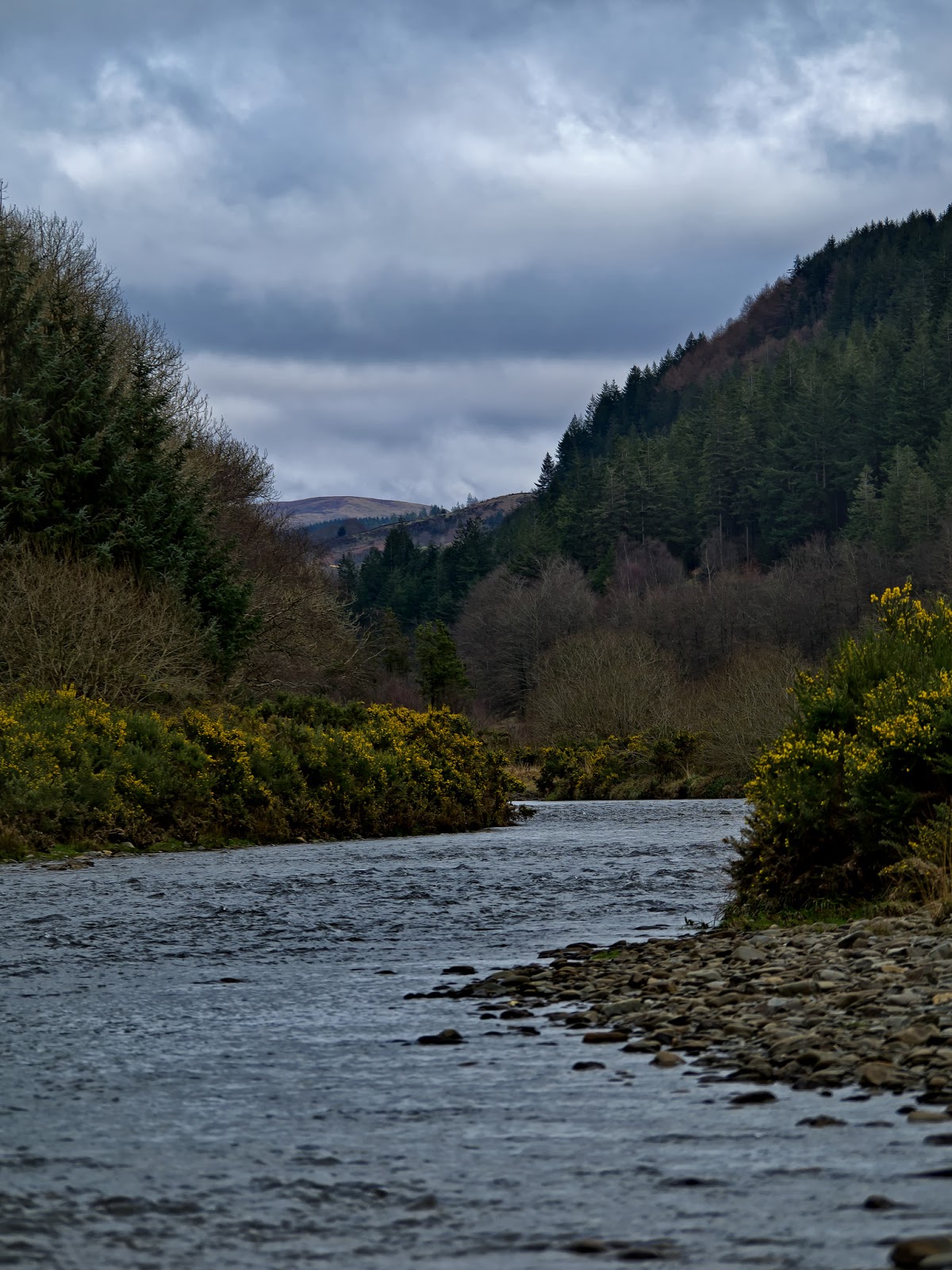
The Ystwyth in Mid-Wales. All being well at some
point this year this view will include me, mid-river!
- Visit the Outer Hebrides; specifically fly into the only commercial airport in the world where the runway is on a beach - Barra - the southern most island in the Outer Hebrides island chain. (Flying this route was my dream job when I was a teenager. This trip is a birthday present for a 'milestone' birthday this year - thank you to my beautiful wife and my parents-in-law for making this possible)
- Visit the Isle of Skye for a family holiday
- Hopefully climb Ben Nevis again on the way to Skye.
- Walk / Swim / Raft from 'source to sea' down the River Ystwyth in Mid-Wales.
- Do the UK Three Peaks with my brothers

That will do to be going along with, there are a few others which have bigger question marks hanging over them at the minute, mostly just down to available spare time, so I won't add them yet but hopefully there may be a few extras to add to this list before years end.

The fitness concern is largely centered on the Three Peaks attempt. I don't just want to complete it, I want to complete it well and if not easily then at least without serious discomfort. It's for this reason that I will be trying to make the most of working in the Peak District and actually going out for a walk, usually up a steep hill, before work or during lunch breaks and so forth. To provide one more level of motivation I signed up to a few 'challenges issued by UK outdoor magazines;
- the #walk1000miles 2018 challenge (Country Walking Magazine), and
- the #everestanywhere challenge (Trail Magazine).

Both should be eminently do-able provided I pull my finger out and actually start making better use of my time... what this essentially amounts to is me learning not to sleep as much! I'll leave this there for now - if all this comes off there will be some stories to tell, pictures to share and hopefully maybe even a little inspiration to give. Not that I expect anyone to be inspired by my efforts, but rather I hope that you may be inspired by the places I visit and the enjoyment I hope to derive from the journeys to get there!


Richard


Saturday, 30 December 2017

'The Best Books' - Robert McFarlane: The Wild Places


Reading is a luxury I don't get in large quantities these days - work, family, church, part time work (glorified hobbies), photography - they all take their chunk of time. As a kid I used to read loads and when we first got married, before I started University, we both used to read loads together - probably because we couldn't afford to do much else! These days what would have been my typical reading time - the period between going to bed and falling asleep - is often so short that reading the blurb in one go would be a struggle.

Anyway - that slightly off topic waffle goes to explain why it took me nearly two years to finish reading this book, but it was certainly worth persevering!


I'd been aware of Robert Macfarlane as an author for a while but not had an opportunity to read any of his books until a few years ago when I requested a few for a Christmas present (or Birthday... I can't actually remember!). Thereafter I started reading it in fits and spurts as time allowed, which often meant while I was away from home on trips - working in the woods, holidays visiting family and so on - when the normal routines which fill up your day were disrupted enough to free up a bit of time in the day. These are also the times when I am most likely to be able to spare some time for adventure, exploration and time spent out of doors in the peace that the natural world provides, either as a family or occasionally solo. 

And this is the core of the 'The Wild Places' narrative. It is certainly something that resonates with me - an exploration of the last places in the UK which can still be considered as wild, what an adventure! I'm lucky enough to be familiar with a few of the places he visited in the writing of the book. I even read the chapter about coastal wildness - which recounts a visit to Orfordness on the Suffolk coast - the night after a micro-adventure of my own in that area. My in-laws live just a few miles from Shingle Street, the little hamlet where the spit fades away and joins the North Sea. My brother in law had recently acquired a set of inflatable canoes and had been looking for a chance to try them out. Being mid-summer we made the most of the long evening and stole away for a few hours to try the new toys. The sunset canoe expedition which followed is a fond memory which I have written about before and took us up river toward Orford flanked by Orfordness to the East and the salt marsh on our landward side. We stopped briefly on the shingle to enjoy the views before heading back to our start point... a journey made far more difficult by the tide which had turned and was now racing in. We ended up walking back to the car, beaten by the speed of the inbound tide which rendered our inexperienced paddling completely useless as we struggled to not be drawn back inland, let alone making significant forward progress!

Suffolk was among the tamer landscapes and habitats described. Trips to islands, far flung, dune clad coastlines, limestone pavements and the hidden world within there shaded grykes, windswept moorland, barren mountains tops and snow covered bogs with the shadow of ancient woodland are all described in a detail which simultaneously transports you there in person while instilling a burning desire to make a similar pilgrimage to such places yourself . Ever since reading about a night Macfarlane spent on top of Ben Hope near the north coast of Scotland I have been trying to find a reason to justify the 1000 mile round trip to see it for myself. I haven't found a reason yet... but it isn't going anywhere, I'll figure it out someday. 

Of course his trip to the Hope Valley in Derbyshire to look for mountain hares is something I can recreate far more simply - given that my office is in the valley next door! That's not to belittle the experience, I still love to see the white hares bounding away, particularly when there is snow on the ground. So far this year I have been tied up with office work and haven't been up on the hills yet to see them in their winter coats. Luckily there is certainly good opportunity for me to do so in the new year and I'll be sure the make the most of it! It is easy to forgot - working there everyday - that to so many people in the UK coming to the Peak District is a way to escape the daily grind of work, whereas for me, it is work. 

The picture at the top of the page was taken while on a short trip of my own - I was on route to watch a rugby game in Cardiff with my family. Having spent many of my formative childhood years in Wales I made the most of the opportunity by travelling down through Wales revisiting old haunts. In the evening I travelled to the end of the Gower Peninsula on the south coast of Wales to watch the sun go down over Worms Head. It wasn't long after I had acquired my new camera and I attempted to capture the scene with a time lapse... it wasn't the greatest success (you can watch it here if you really want!), but it gave me an hour on a wild coastline to sit in beautiful surroundings and read about Macfarlane making a trip to a comparable coastline a few hundred miles north, only he was approaching from the sea.

I won't go on - discussions of this nature get my mind racing through the long list of places I'd like to visit. And while patience is certainly a virtue it's not one I'm blessed with in abundance. There is a real risk I will lay awake at night dreaming of the Cairngorms, or the Outer Hebrides, or the wild rivers of mid-wales where I swam as a child, or the rugged coastline of Devon where I camped as a teenager... you see what I mean!? Much like 'The Wild Places', my list of dream destinations are largely in the UK. We are blessed with such a diverse island, or series of islands, that international travel isn't necessary if you goal is to visit wild places. If you're struggling for ideas then reading 'The Wild Places' will certainly give you food for thought, in fact it will be a feast! 

Follow Robert Macfarlane on:
Twitter:       @RobGMacfarlane
Instagram:   @robgmacfarlane

Alternatively have a look at all of his books here at his Amazon author profile.


Wednesday, 6 December 2017

Working in Conservation: Moors for the Future Partnership - My Day Job

I have often mentioned 'work' and posted images I've taken while out working or on my way to work or some variation on those themes. I've been asked by several people what on earth it is that I do for work! So I wanted to answer that question in some detail. I'd also like to use this to kick start an ongoing series on working in conservation in the UK. 

In later posts I'll talk about my work at The Riddy Wood Project and give my perspective on the good, the bad and the ugly (and the beautiful) of working in the conservation sector in one way or another over the last 7 or so years (wow, it has been that long!). I have no doubt there will be other posts to come after that too.

------------------- 

Since June 2016 I've been working for the Moors for the Future Partnership full time as a Conservation Works Officer. You could say it is my first proper job in the conservation sector as prior to that I had only done part time, seasonal or voluntary jobs. Moors for the Future are a partnership organisation headed up by the Peak District National Park Authority but also including the National Trust, the RSPB and several water companies. As the name suggests the focus of the partnership is protecting moorlands (in the Peak District and South Pennines) for future generations.

Edale Valley, Derbyshire
Not quite the view from my office, but my
office is in this valley, just out of frame (left) 
There is plenty of information on the Moors for the Future website (linked above) but to give a quick run down: the peatlands of the South Pennines are (or were at any rate) some of the most degraded anywhere in the world as a result of years of atmospheric pollution, drainage and wildfire. This came about largely as a result of the industrial centres surrounding the moors and the air pollution that resulted from those industries, but also from short sighted agricultural policies and unsympathetic management practices. This damage resulted in large scale loss of critical plant species from the moors and eventually led to complete vegetation loss over large areas and the associated erosion of the peat soils. This causes problems down stream as well as up on the moors as the peat soil washed off the hills, silted up reservoirs and increased the cost of water treatment among other things.

In about 2003, what was to become Moors for the Future (MFF) started work to address these issues. Fast forward 13 years through several rounds of funding from various sources and of various sizes and we get to 2016 when I joined the team. The year before a new funding stream had been secured, a second EU LIFE funded project called MoorLIFE2020. At the time it was the largest grant from the LIFE programme for a environmental conservation project in the UK - 12 million. The increase in work resulting from this new funding stream required extra capacity and I was in the right place at the right time - often the way jobs in conservation come about - and got one of the two roles being offered.

On this occasion the 'right place' happened to be working with a conservation works contractor - Aitch Conservation - building a footpath across Brown Knoll, an exposed ridge to the south-west of Kinder Scout in the Peak District. The 'right time' was the winter and early spring and it didn't always feel like the 'right time' to be working up there to be honest! The footpath project was being run by MFF and during my time working on the path I got to know a few of the staff a little who tipped me off to the upcoming recruitment and suggested I may want to apply. I did and here I am.

But what do I actually do? I work in the CaLM team (Countryside and Land Management - there is a certain irony in the acronym I have to say!) which is responsible for the physical 'on the ground' conservation and restoration work such as bare peat re-vegetation, gully blocking and sphagnum reintroduction. (There are also Science and Communication teams within MFF which do pretty much what they say on the tin.) We work as a project management company when it comes to our works delivery and as such we don't actually do any of the works ourselves, rather we contract it out to specialist contractors. 

I am one of a team of 6 Conservation Works Officers (CWO's) although we are soon to be expanding that number. Our day to day job includes land owner engagement, site surveys, writing work proposals, tendering for conservation work contracts and supervising contractors. Throw in the odd bit of preparing funding bids, working with Natural England as moorland restoration experts and occasionally assisting other teams with public presentations and you have a fairly comprehensive idea of what I do. 

Moving heather brash for a bare peat re-vegetation
contract in the Peak District National Park. 
Oh, and helicopters - nearly forgot. Understandably that catches a lot of peoples attention. As so much of the work we coordinate takes place miles from any sort of road, and often requires transporting tonnes of material (literally - often hundreds, and in some rare cases even thousands of tonnes) the only way to get those materials to the site is by helicopter - and yes, I do occasionally get to have a ride! Yes, it is cool. No, the novelty hasn't worn off yet. One of the better perks of the job for sure!  

So I do spend a fair bit of time outdoors 'in the line of duty', certainly more than most office dwelling folks. And because of the nature of the work, when I am out doors, it's normally in some pretty scenic places. Predominantly at the minute in the northern half of the Peak District National Park, but also further north into the South Pennines on occasion and for some recent projects short spells into the South West Peak too. But it certainly isn't always in good weather. In fact between April and August, so certainly the best 2 or 3 months of the three, we're not really allowed up on the hills at all on account of that being the breeding season of the ground nesting birds which breed in the uplands. This and other time restrictions means that the majority of our conservation works contracts run over the autumn and winter months, which is always when we spend the largest proportion of our time out and about. BUT - I subscribe to the philosophy that even a bad day out of doors is better than a good one stuck inside, so I can live with that.

It's not all helicopters and hill walking of course - writing contracts and managing budgets doesn't exactly get my heart racing and that type of task makes up a pretty big chunk of my day to day work. And while the scenery of my commute through the UK's original National Park takes some beating, at least on the days when you can see it through the fog and low cloud (as hopefully my photo's regularly illustrate - take a look at my hash tag #aconservationistscommute on Instagram) nothing makes the 70 mile a day round trip commute any shorter.

So that's what I do for work - is it a perfect job? Not for me perhaps, because I tend towards being a hands on kind of person. In an ideal world I'd prefer to get my own hands dirty and do at least some of the work myself. Is it a good job? Definitely. Because the changes which are made through the work we do (or coordinate and facilitate) make real, noticeable and measureable differences to the habitats we are working on, and by doing so, provide significant benefits to local communities.

Next time I'll fill you in on my work on The Riddy Wood Project which is how I get my needed fix of hands on conservation work and hard, outdoors manual labour!

Richard